カードe The e-Reader years · 2001–2004

Every card a cartridge

For three years Pokémon cards carried games in their edges. Slide one through the reader on a Game Boy Advance and a strip of dots became a minigame, a cartoon, a song, or an attack nobody could see.

ID: CH-01-#目に見えない価値

Value you can’t see

The Pokémon card game was five years old in 2001, and at Creatures, the company that made it, the head of its card game studio, Takumi Akabane, had wanted to change it while it was still a craze: the longer a craze lasts, he said, the thinner it gets. You can always see what a trading card is worth, a rare Pokémon looks rare. He wanted cards with something in them you couldn’t see, a value you’d only find out about later.

So Creatures went looking for a way to hide things in a card, with HAL Laboratory. They thought about invisible ink, printing that heat could redraw, pictures that changed with a magnet. Then they came across the dot code of Olympus, the camera maker: patterns of dots too fine to notice, which could hold more data than anything else. It took about two years from the first search to cards in the shops.

The dots needed something to read them, something handheld that children already had, and the Game Boy Advance happened to be in the making. Nintendo joined in, and the answer was a reader that plugs into its cartridge slot, designed by HAL with Olympus’s help: the cards would be the cartridges.

A card with a value you can’t see, I thought, would be a card that had evolved.

Takumi Akabane of Creatures, to Nintendo Online Magazine, November 2001 (our translation)

Point at each card, or tap it: our own little re-enactments of the ideas, not prototypes.

ID: CH-02-#ベースコードとサイドコード

Two edges of dots

Creatures first thought of printing code on all four edges. It looked ugly, and swiping four edges was a chore, so the cards got two strips: a long one down the left side and a short one along the bottom.

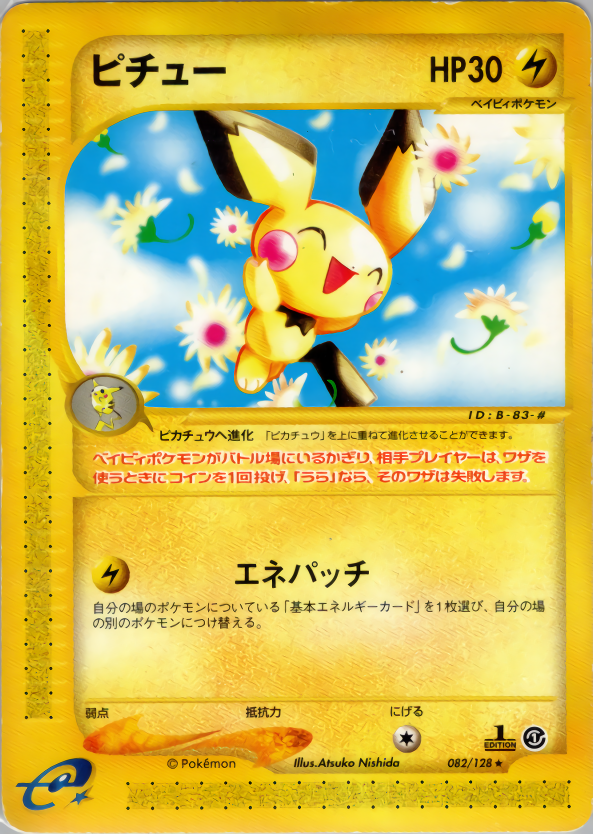
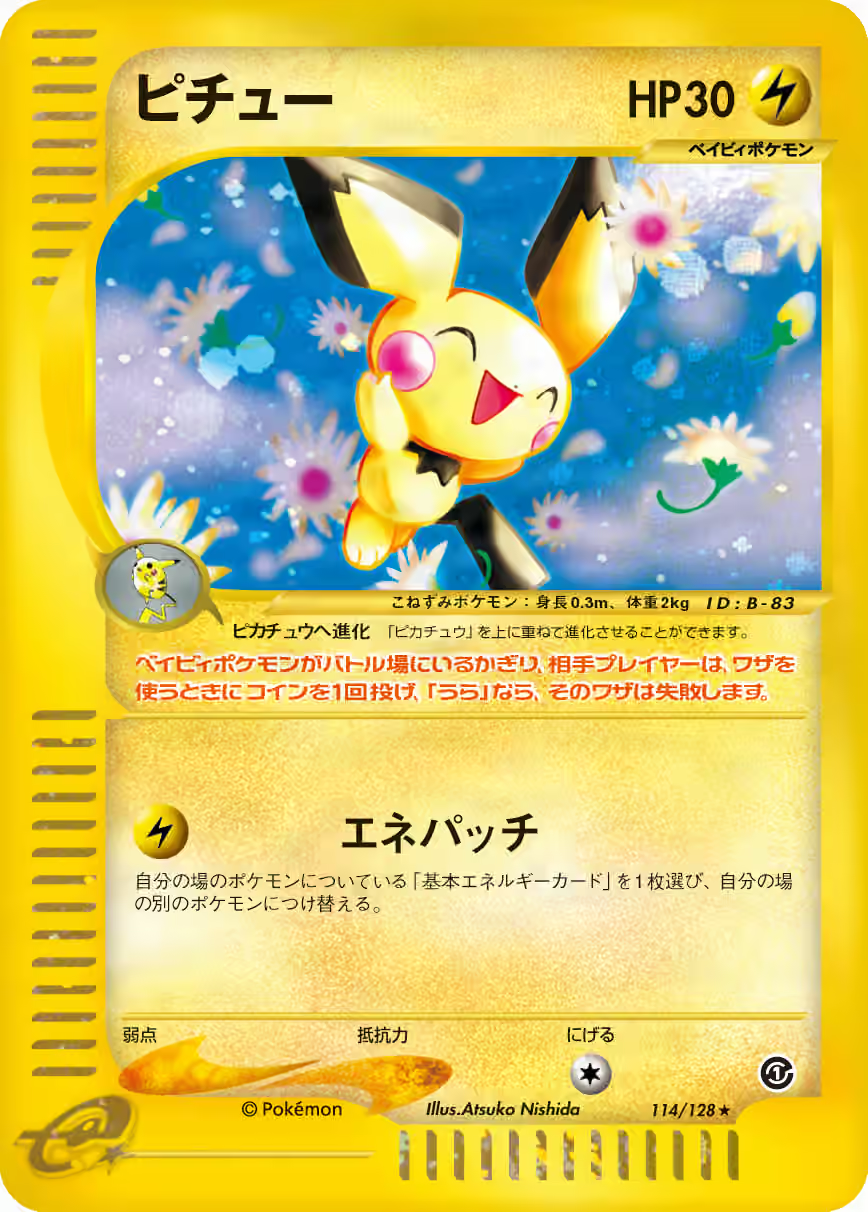
Pichu, Base Expansion Pack 082/128, the Japanese e-Card1234

Japanese Pichu, Base Expansion Pack 082/128. Point or tap to look closer.

  1. The long strip

    The side code: about 2.2 kilobytes, enough for a cartoon, a hidden attack, a tune or a piece of a minigame. On some cards it’s left empty, and stripes fill its place.

  2. The short strip

    The base code: about 1.4 kilobytes. Swipe it and the screen shows the Pokémon’s Pokédex entry, its evolutions and what the long strip holds.

  3. The ID

    ID: B-83-#: a letter for the pack (B for the Base Expansion Pack, the one English players knew as Expedition), a number, and # when there’s only one version of the card, a or b when there are two.

  4. The e

    The mark of the Pokémon Card e series, in the corner of every card made to be read.

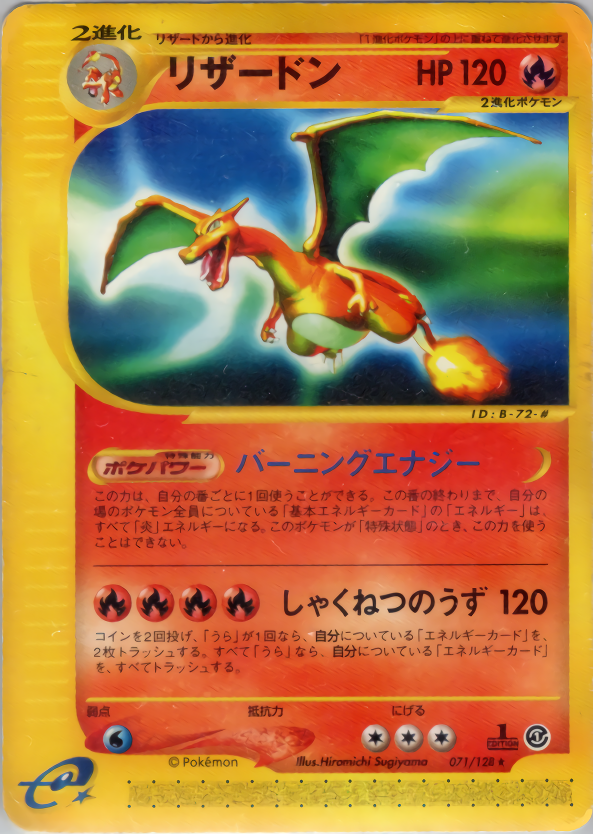
Charizard 071/128, the rare
The rare. Charizard 071: a short strip of dots along the bottom.
Charizard 103/128, the holo
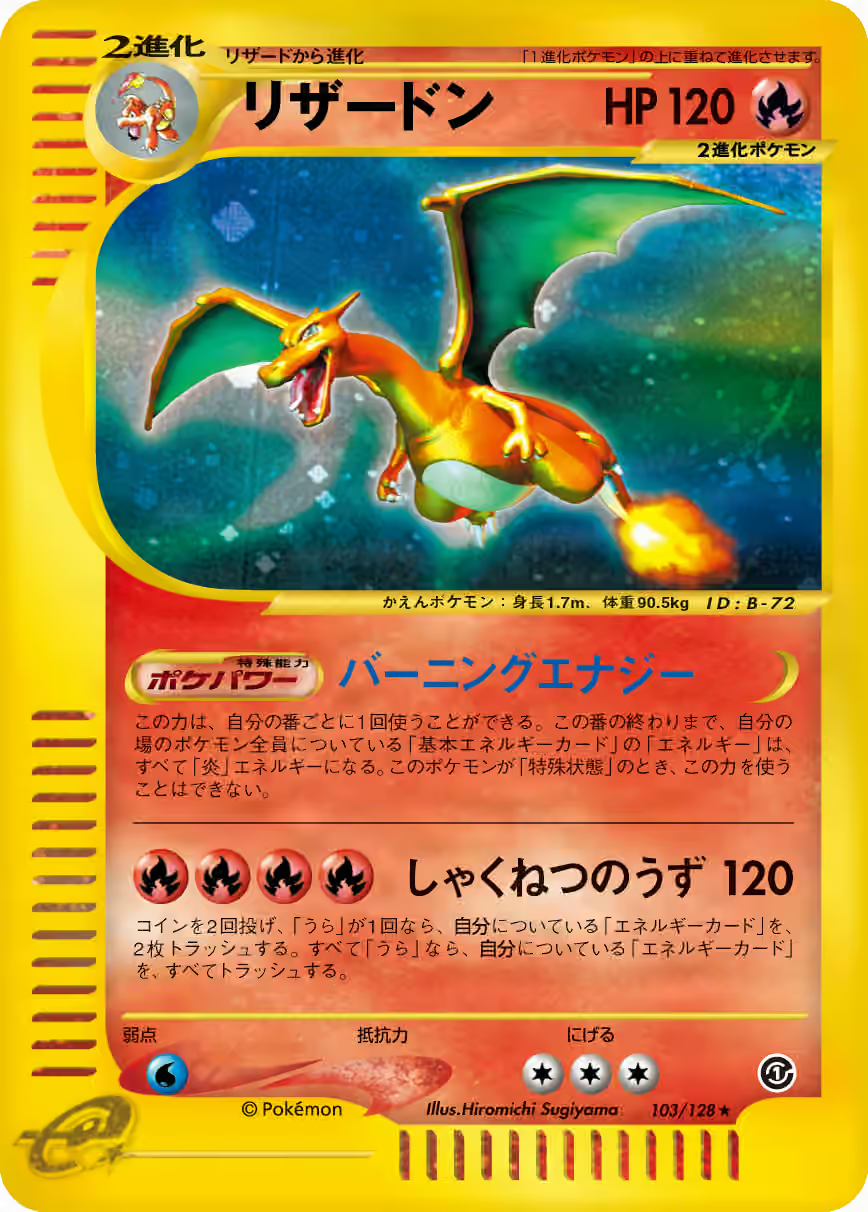
The holo. Charizard 103: stripes where the dots would be, and the species, height and weight under the picture instead.

The reader can’t see dots through foil. So every holo also comes as a plain rare with the same picture and the dots, which is why Expedition’s Mew is 19 as a holo and 55 as a rare, and why Aquapolis and Skyridge number their holos H1 to H32 apart from everything else.

ID: CH-03-#カードeリーダー

The reader that shrank

The reading module was big and the team thought the reader might need its own batteries, so the first prototype was a brick. Tsunekazu Ishihara held it up when the Game Boy Advance was announced in Tokyo on 7 March 2001, and everybody near the project said the same thing: too big. It turned out the Game Boy Advance could power it, and could turn dots into data itself, the job Olympus’s own readers gave a chip of their own. The reader shrank to 95 by 98.6 millimetres and 70 grams.

The first design switched itself on when a card pressed a switch on its way through. That scratched the cards, so the switch went: the reader knows a card is there from the code. Each block of dots is numbered, so the reader knows which blocks it has and which it’s still missing, and when it has them all, the game starts.

Printing the dots

Dots that ran together or broke apart couldn’t be read, so the printers ran thousands of test cards to get them right. A card cut a fraction off line put its code where the sensor wasn’t, so the cutting had to improve too. The e-Cards were made differently from every Pokémon card before them, and checked harder.

The sweat test

Cards get shuffled, bent and handled with sweaty fingers. So HAL warmed a room to about 40°C and had part-timers shuffle cards in it for about a week. The cards still read, more or less.

  1. Shown in Tokyo, with the Game Boy Advance
  2. Card e Reader, Japan, with the first e-Card pack and a starter deck
  3. e-Reader, North America, $39.95, the day after Expedition
  4. Card e Reader+, Japan, with a link cable port
  5. e-Reader, Australia. Never in Europe, though its shops sold the cards
Pichu, the hole-punched kiosk copy
Pichu
Hoppip, the hole-punched kiosk copy
Hoppip

Try me

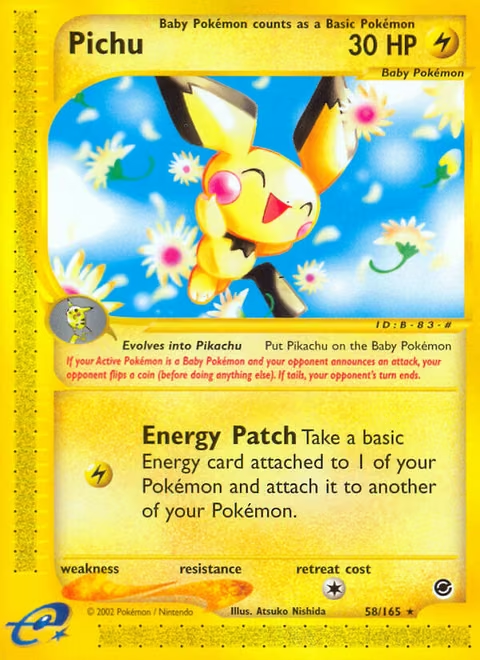
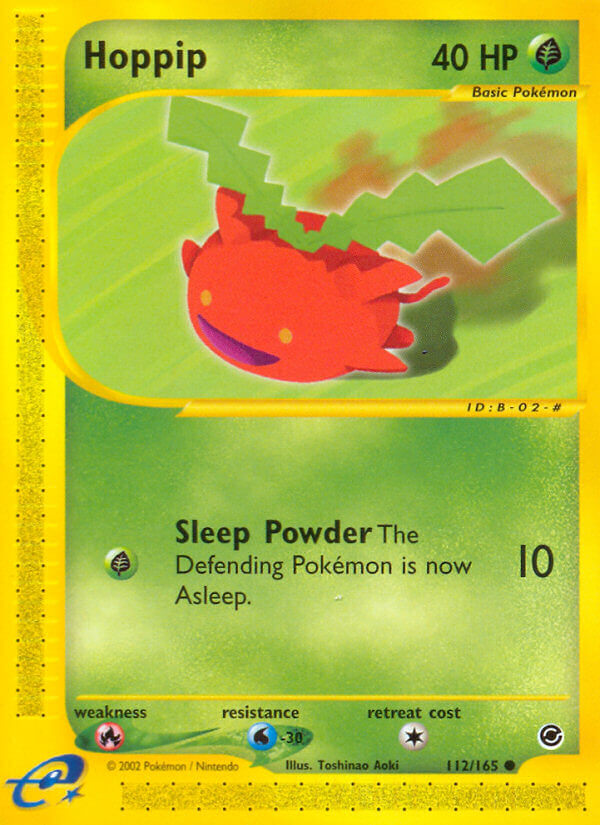
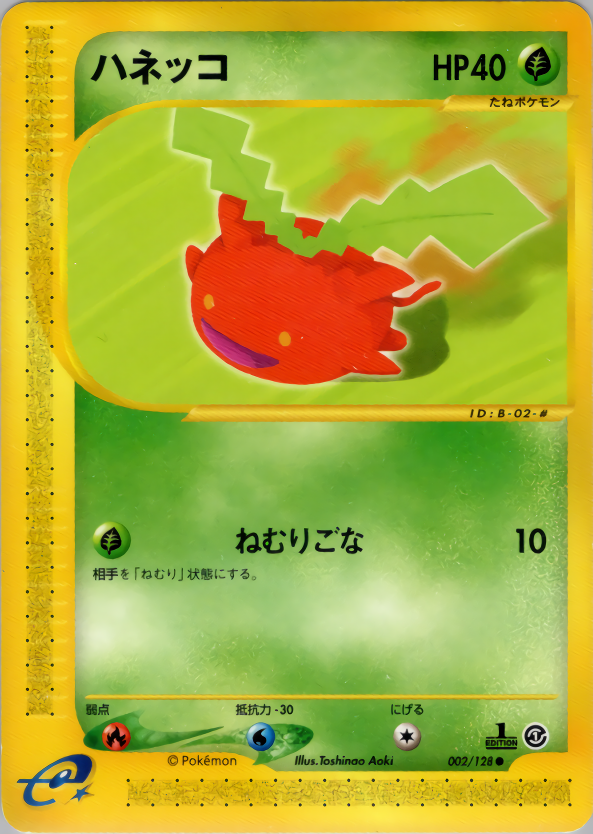
American shops got kiosks with an e-Reader to try, and the cards hung from them on a metal cable through a punched hole so nobody walked off with them: Pichu and Hoppip, which together play Hold Down Hoppip, and a Game & Watch Manhole card. At E3 that May, Nintendo had handed out the same two in packs, early prints with Japanese backs. Both kinds are in the dataset with Pichu’s and Hoppip’s other copies.

ID: CH-04-#eゲームmini · eアニメ

Swipe to play

Most games didn’t fit on one card. A minigame was spread over the long strips of up to six cards, a numbered part on each, and it started when the reader had every part, usually from the cards of the Pokémon in it. Creatures called them e-Games mini; the cartoons were e-Anime. Pick one off the shelf and watch its cards go through.

e-Game miniHold Down Hoppipハネッコをとばすな
BA

e-Game mini · Expedition · 2 cards

Hold Down Hoppip ハネッコをとばすな

In Japanese: “Don’t let Hoppip fly away”

You’re Pichu, running between five Hoppip tied down with ropes and tugging each rope before its Hoppip floats off. They pull harder as the game goes on, and it’s over when one drifts off the top of the screen. The e-Reader keeps your best score. It was the game on the shop kiosks.

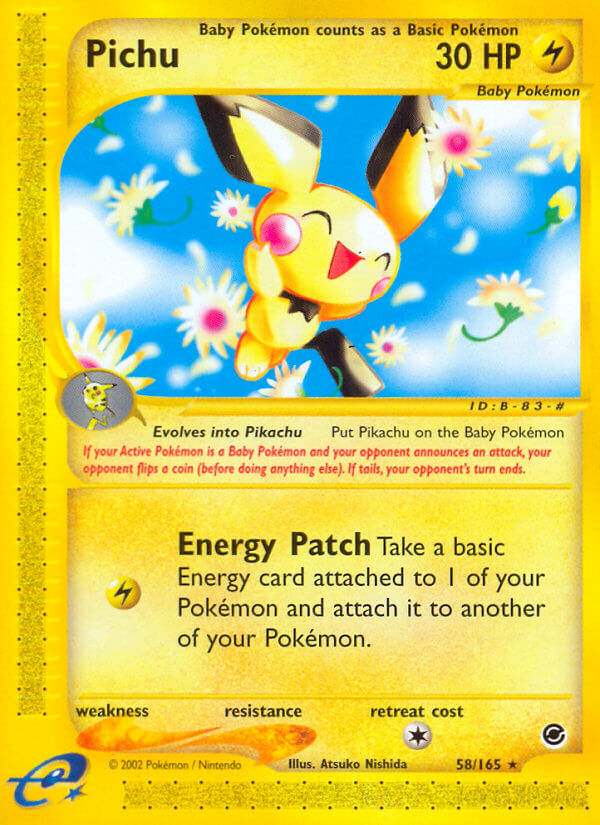
  1. Pichu, Expedition 58/165Pichu Expedition 58/165
  2. Hoppip, Expedition 112/165Hoppip Expedition 112/165
  • You’re Pichu, running between five Hoppip tied down with ropes and tugging each rope before its Hoppip floats off. They pull harder as the game goes on, and it’s over when one drifts off the top of the screen. The e-Reader keeps your best score. It was the game on the shop kiosks.

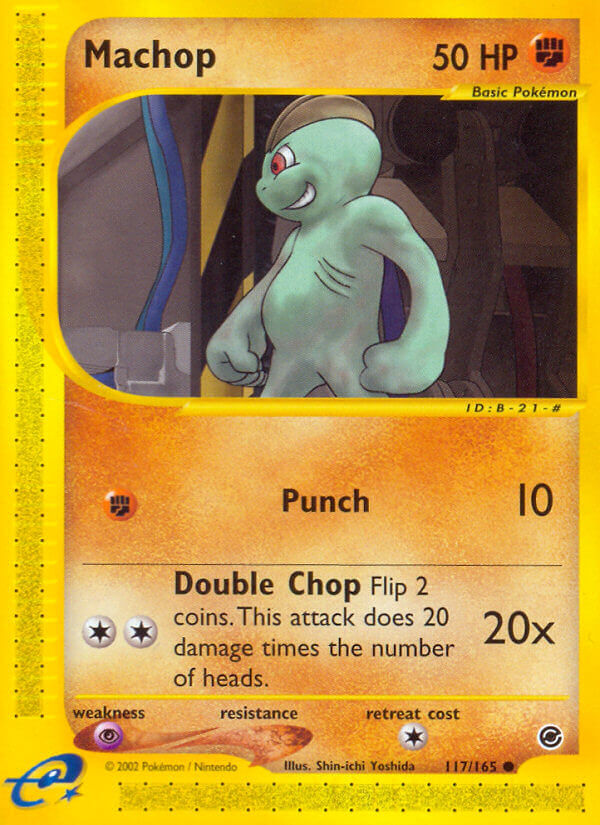
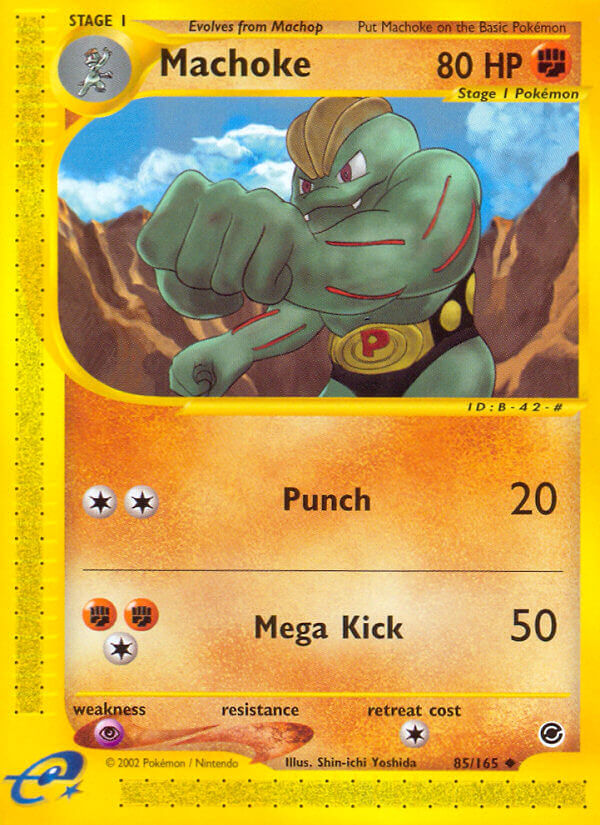
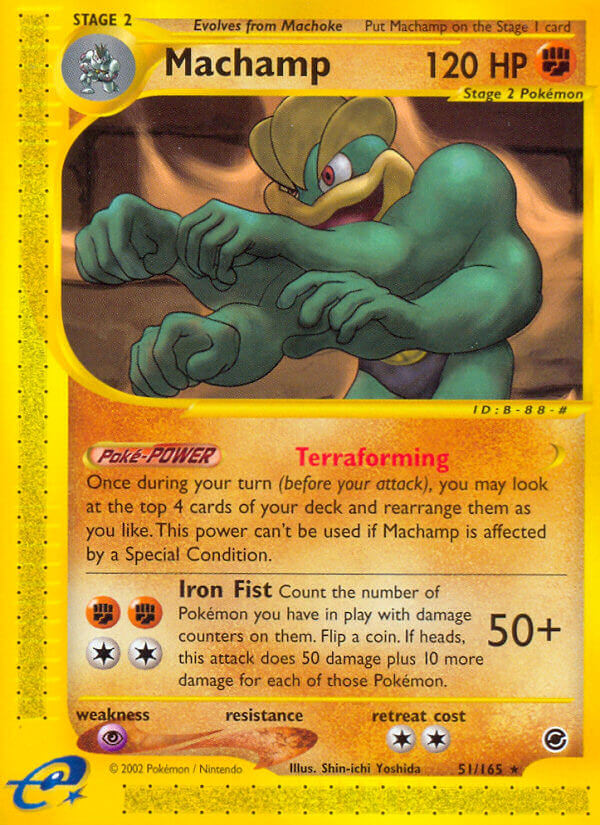
  • Machop smashes a hundred falling rocks. Smash fifty and it evolves into Machoke at the end; smash all of them and it goes on to Machamp. These three cards came in the box with every English e-Reader. You can play it further down this page.

  • Kingler has two minutes to pull as many Goldeen and Magikarp out of the pond as it can. Grab a Cloyster by mistake and it’s stunned for a moment. There’s no winning or losing, only a better score. Junichi Masuda wrote the music.

  • A swimming race against Marill and Golduck: Poliwrath has to touch first. It takes six cards.

  • A cartoon. Dragonite flies over a city and a field of windmills, spots a Pikachu drowning and lifts it out. Play it again and the Pikachu comes up with a Magikarp holding on to it, then a Marill, a Goldeen and a Wobbuffet, all hanging on to each other.

  • Clefairy uses Metronome, and every time you play it something else happens: day turns to night and a Haunter chases it off, or it turns into Explosion, or Clefairy evolves into Clefable and two more Clefairy come to see.

  • One card, one cartoon: Rapidash gallops across a field to a post, and the e-Reader tells you its top speed, different every time you swipe.

  • Doduo runs and jumps over the Pokémon and boulders in its way until it misses one. One of the few games that remembers your high score after you switch off.

  • Sudowoodo sneaks up behind a Totodile to steal its fruit. If Totodile sees it coming, it’s Water Gun.

  • Zubat flies to the end of a dark cave, using Supersonic on the Koffing in its way and picking up white Apricorns for points.

  • A Kingler is throwing Magikarp, Goldeen and Seaking out of the river, and Ditto bounces them back in. It’s the other side of Kingler’s Day: the same Kingler, two sets later.

  • Wobbuffet stands in a field and sends everything back: Counter for boulders, Mirror Coat for sparks. Three mistakes and it’s over.

  • Rapidash jumps through a hundred hoops at different heights; hold A to jump higher. Its two cards were Wizards Black Star promos.

It changed what a card was for. Some children wanted a card because it was strong in a deck, Akabane said, and others because it had the minigame they wanted: another reason to trade. Creatures’ Katsuyoshi Irie compared it to a toy you got first and kept adding parts to.

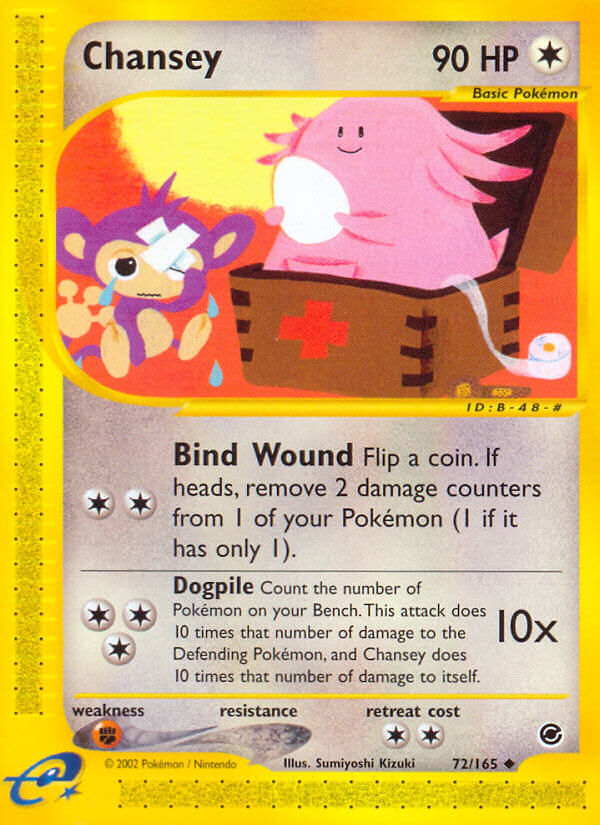
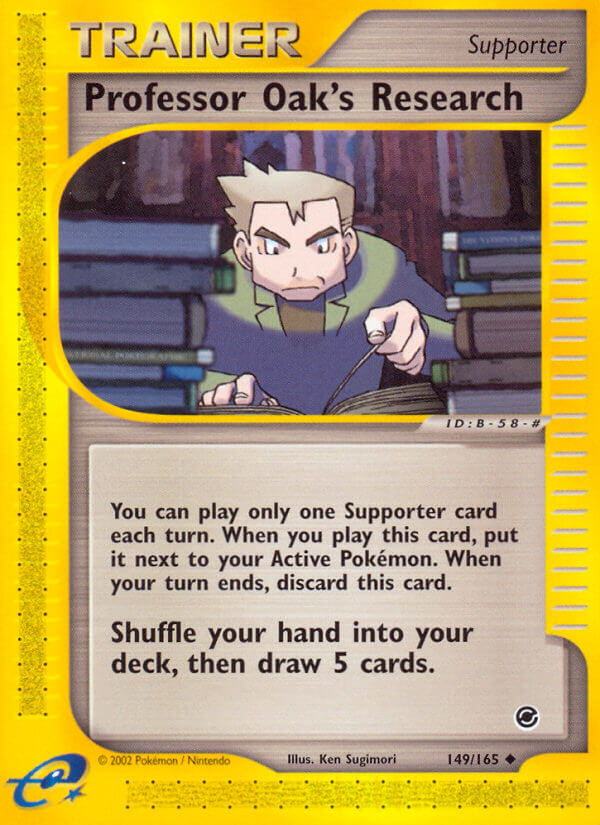
And some cards held a tool instead: Chansey flips a coin for you, Professor Oak’s Research keeps the time for each player like a chess clock. Creatures called those e-Tools.

Chansey, Expedition 72/165
Coin flip
Professor Oak's Research, Expedition 149/165
Duel timer

ID: CH-05-#ワンリキーのしゅぎょう

The game in the box

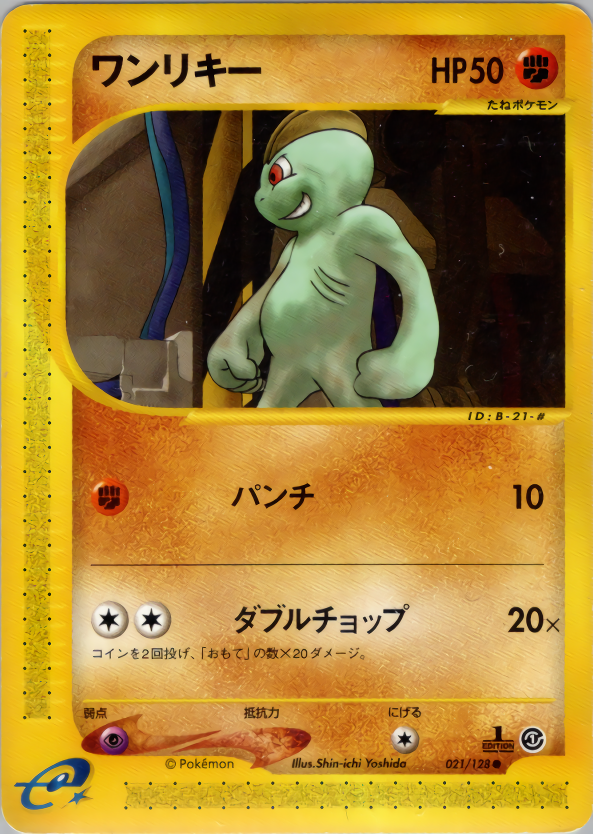
Every English e-Reader came with a sample pack of five cards: a Manhole game, an Animal Crossing card, and Machop, Machoke and Machamp, whose three long strips together held Machop At Work. A rock comes down, Machop punches it. Here it is again, drawn at the Game Boy Advance’s 240 by 160 pixels.

Rocks 000/100

Machop At Work

ワンリキーのしゅぎょう

Punch the rocks before they land on Machop. Smash 50 to evolve; all 100 for the full line.

  1. Machop, Expedition 117/165Start
  2. Machoke, Expedition 85/16550 rocks
  3. Machamp, Expedition 51/165100 rocks

Arrow keys or the pad to move, space or A to punch. A rock that lands beside Machop bounces away and comes back later; one that lands on it ends the game.

ID: CH-06-#かくしワザ

Attacks nobody could see

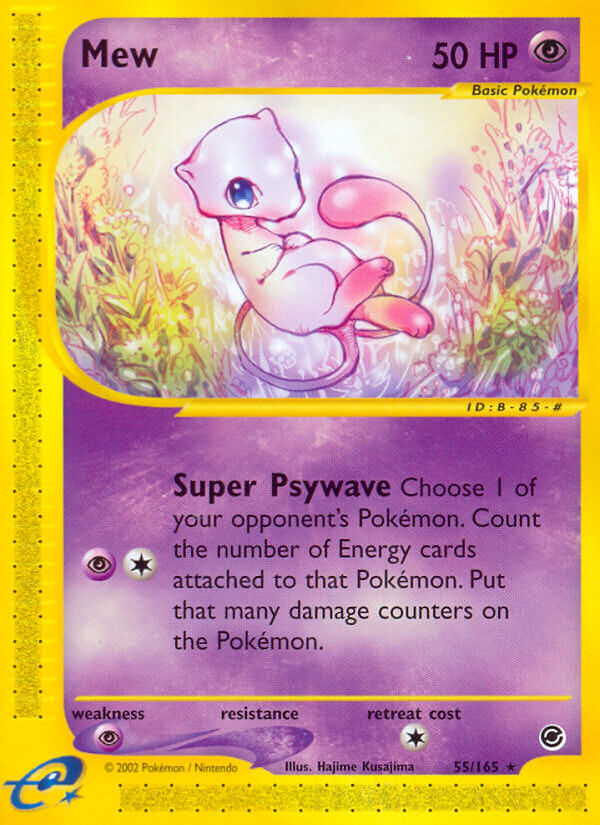
Eleven cards in Expedition, Aquapolis and Skyridge had an attack or a Poké-Power that wasn’t printed on them. Swipe the card in the middle of a game and the e-Reader drew a number from 00 to 99, and the card’s program decided what it did. They were never allowed in tournaments.

Mew, Expedition 55/165
Mew Expedition 55/165

Hidden attack

Strange Wave

For Psychic and Colorless: “This attack may cause a random effect to the Defending Pokémon.” Only the plain rare carries it; the holo Mew has no long strip.

The effect

Poisoned00–14Burned15–29Asleep30–77Paralyzed78–87Confused88–97Burned and Confused98–99


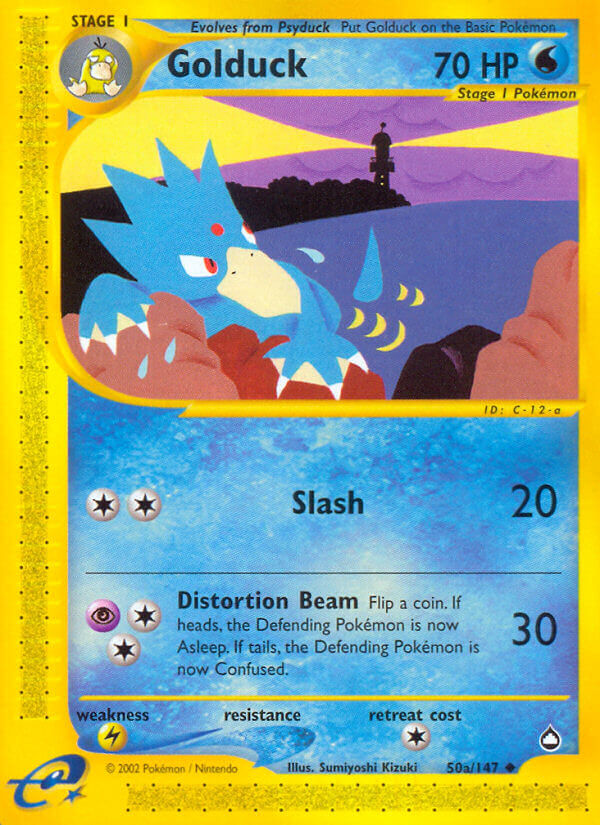
Golduck, Aquapolis 50a/147Golduck, Aquapolis 50b (pictured: 50a, which looks the same)

Twins

Aquapolis printed four Pokémon twice: Golduck, Drowzee, Mr. Mime and Porygon, numbered a and b. Golduck 50a, C-12-a, and 50b, C-12-b, look the same but for that letter. What differs is the dots: 50a’s long strip is a level for Construction: Action, and 50b’s is Spiral Damage.

ID: CH-07-#e GAME ZERO

Build it yourself

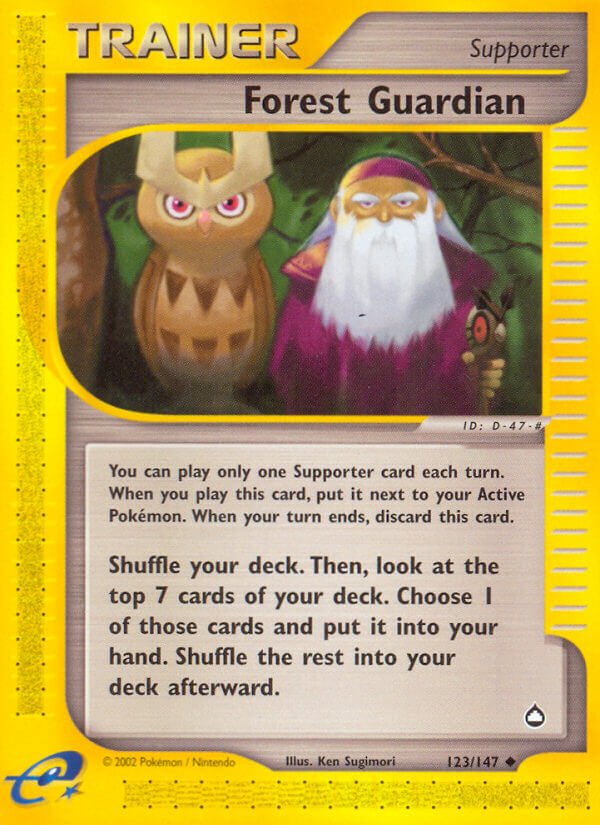
In 2001 Creatures had hinted at a secret: games that changed as you changed the cards. They became Construction: Action and Construction: Melody Box, built from cards spread through the sets. The e-Reader saved neither; leave, and you swiped your cards again.

Forest Guardian, Aquapolis 123/147
Player
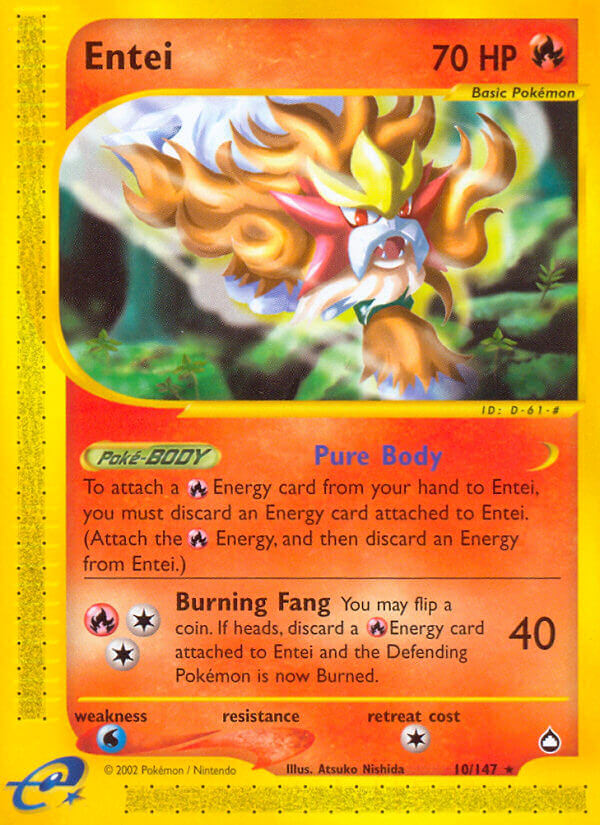
  1. Entei, Aquapolis 10/147Stage 1
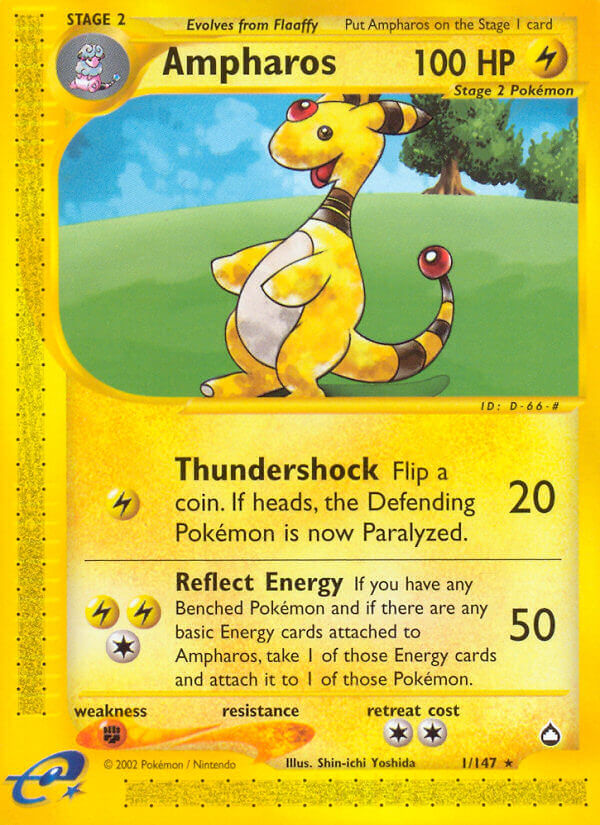
  2. Ampharos, Aquapolis 1/147Stage 2
  3. Golduck, Aquapolis 50a/147Stage 3

Construction: Action

A platform game built from cards. Swipe one Trainer as the player, like Forest Guardian or Relic Hunter, each running and jumping differently, then up to six Pokémon as stages. Each stage holds its Pokémon to catch with thrown Poké Balls before the timer runs out.

Construction: Melody Box

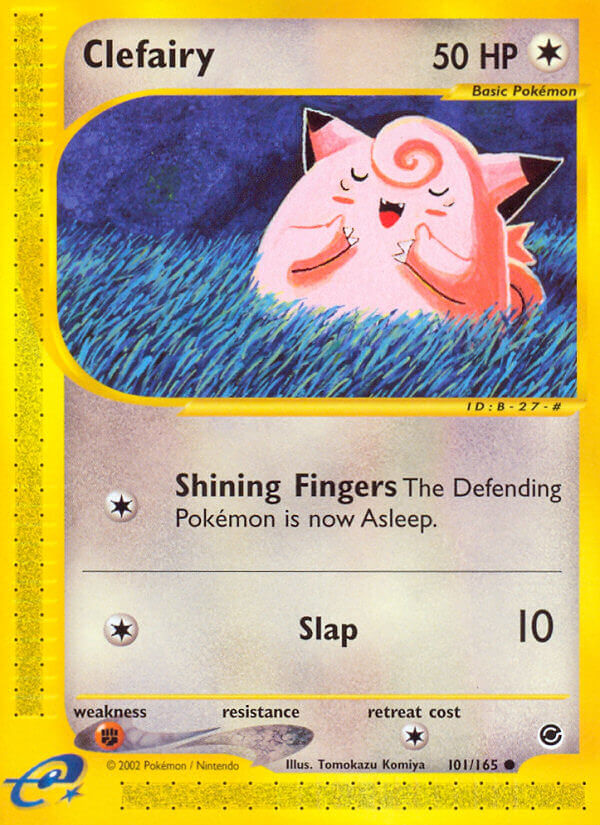
Music cards hold a tune, some from the games and some from the concert hall; sound cards change the instrument, and pattern cards the picture behind. Clefairy conducts: move it up and down for the pitch, left and right for the speed. These three tunes are the classical ones, played here by your browser.

Pick a music cardPitch 0 · Speed ×1.0

Drag Clefairy: up and down for pitch, left and right for speed.

Music Tap to play, again to stop

Sound The instrument

Pattern The background

ID: CH-08-#日本だけのカードe

Japan got more

In Japan the e-Cards turned up everywhere: on planes, in Happy Meals, at the cinema, at railway stations. Many carried games that never left the country.

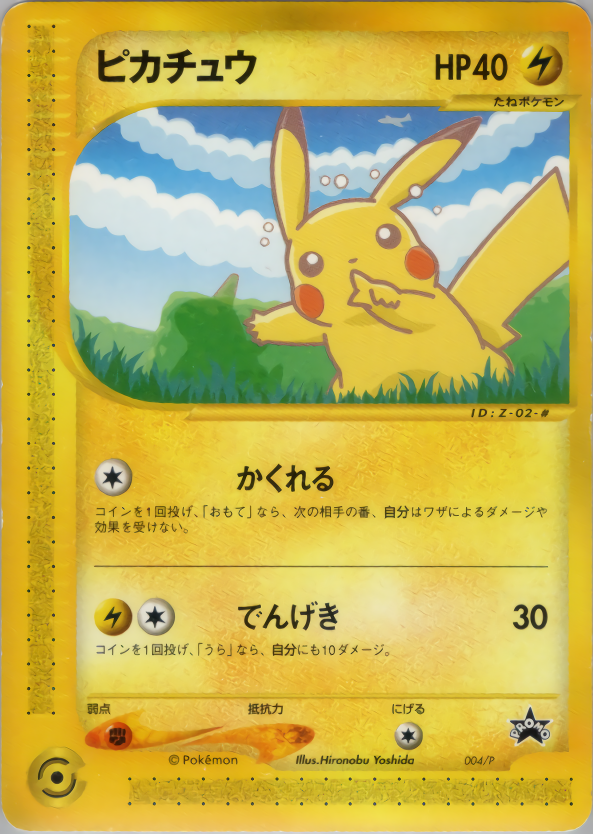
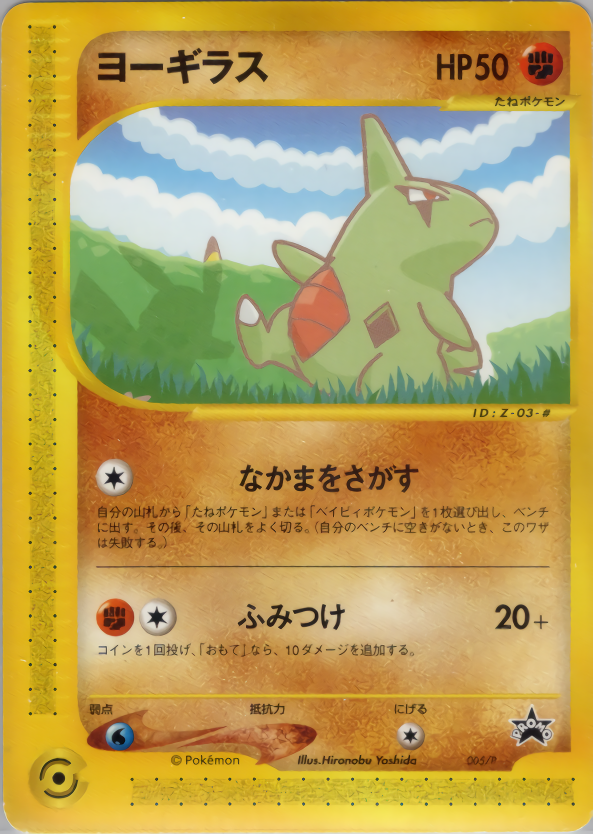
Pikachu 004/PLarvitar 005/P

On a plane · summer 2001

Hide and seek

Before there was a reader to buy, All Nippon Airways mailed this pair to anyone who flew two domestic flights that summer and sent in the stubs. Each card shows the other Pokémon hiding behind a hedge, and together they play a cartoon, Exciting Hide and Seek, in which the two take turns hiding.
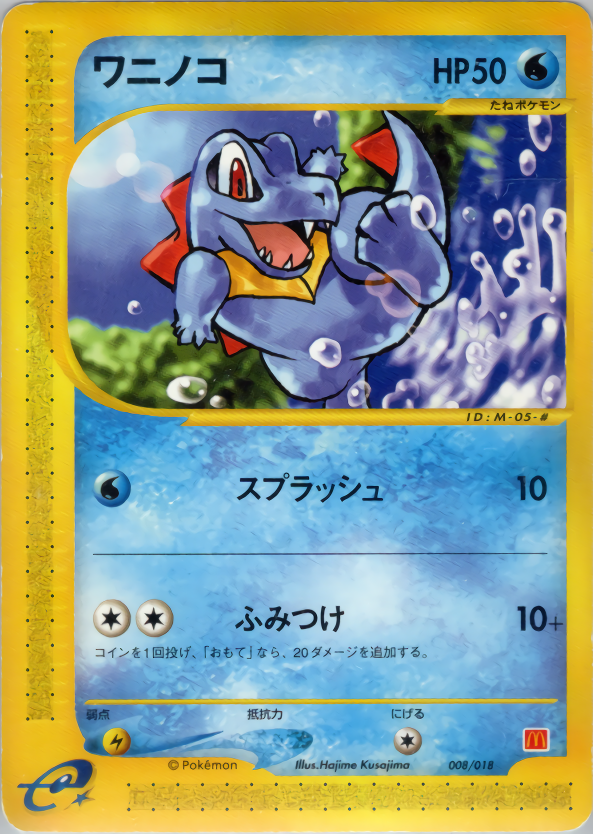
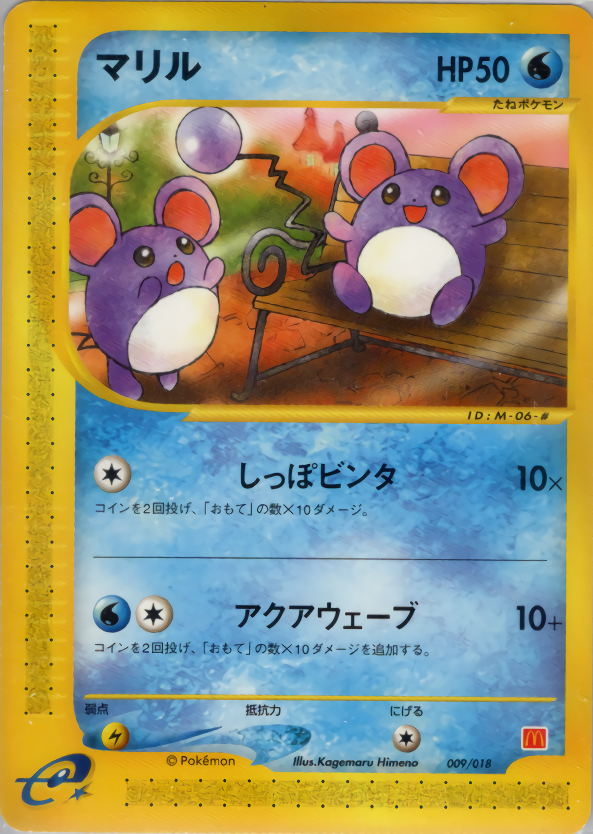
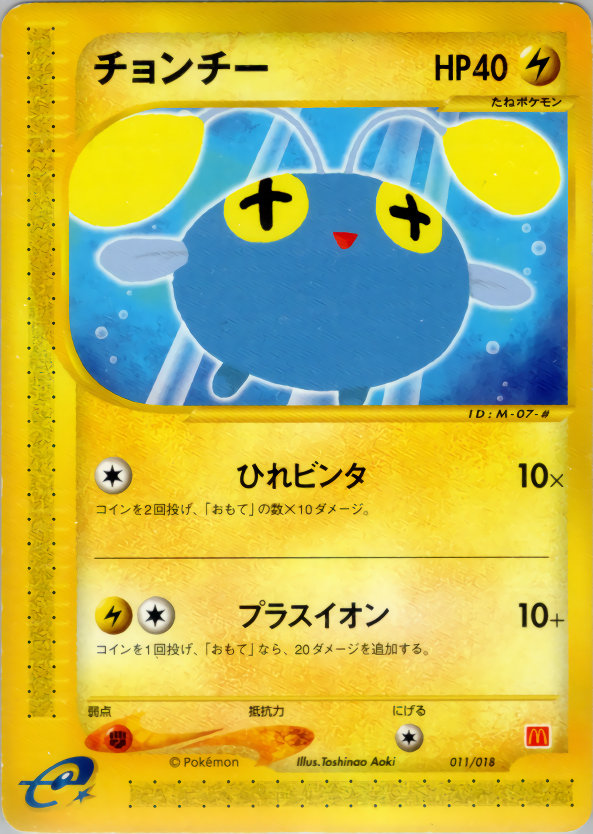
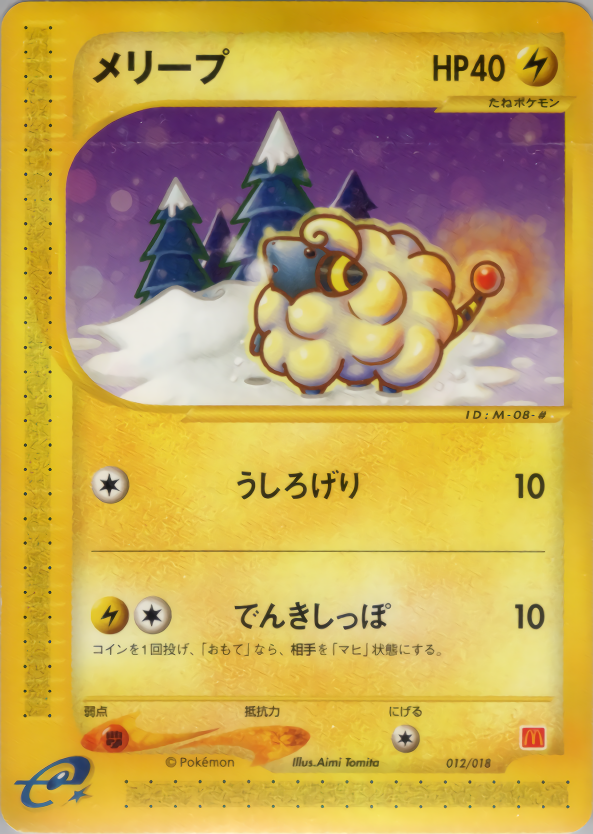
Totodile, McDonald’s Minimum PackMarill, McDonald’s Minimum PackChinchou, McDonald’s Minimum PackMareep, McDonald’s Minimum Pack

At McDonald’s · January 2002

Wooper’s Juggling Game

For a month in 2002, anyone buying a meal at McDonald’s in Japan could add a six-card Minimum Pack for 180 yen. Four of the packs’ cards, Totodile, Marill, Chinchou and Mareep, together play a game in which Wooper keeps Poliwag and Totodile in the air with Water Gun. Reach 3,000 points and Psyduck joins in, needing two blasts.

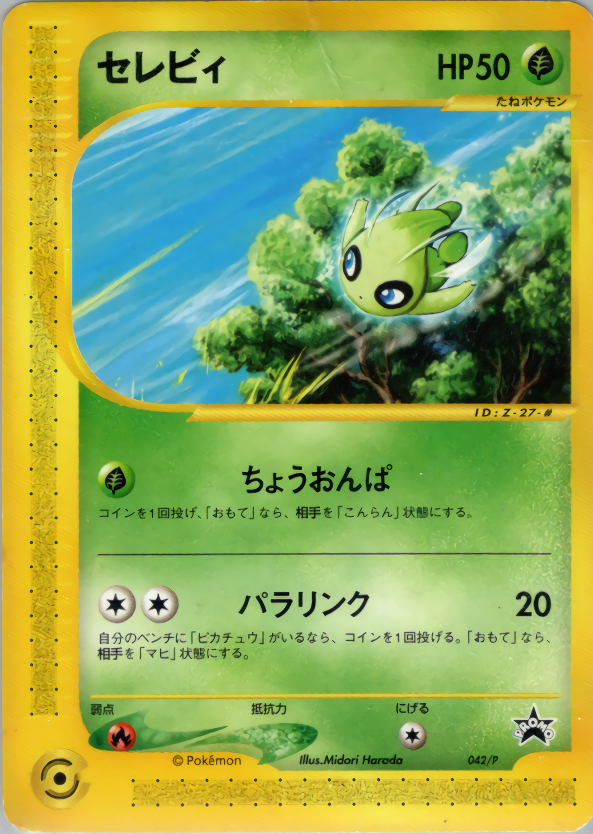
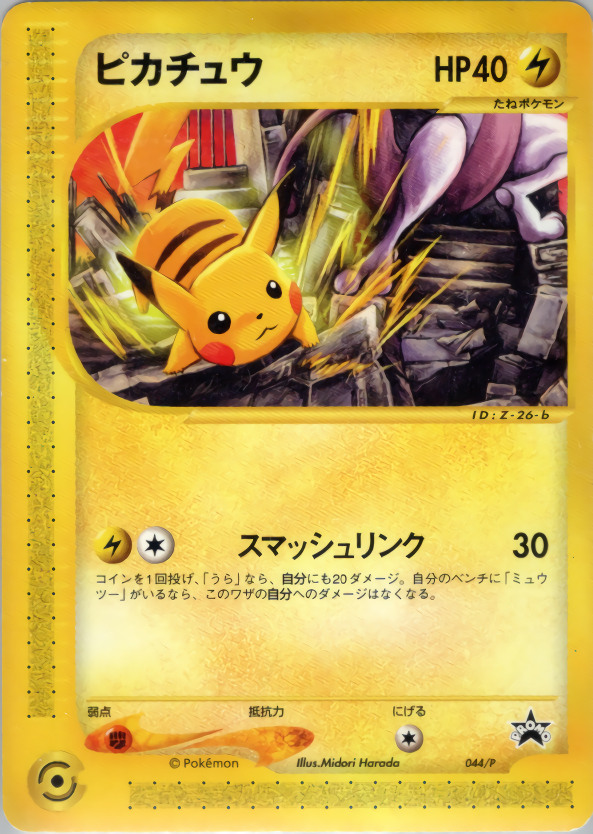
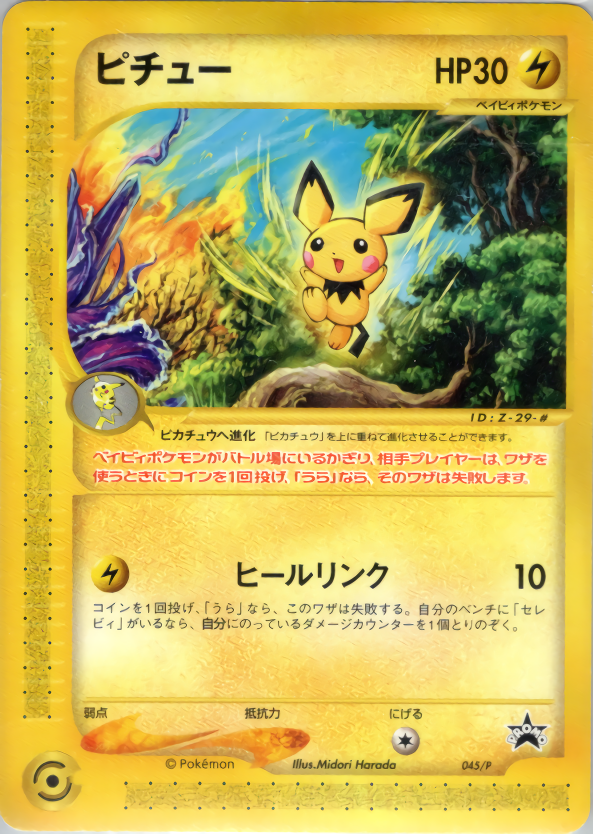
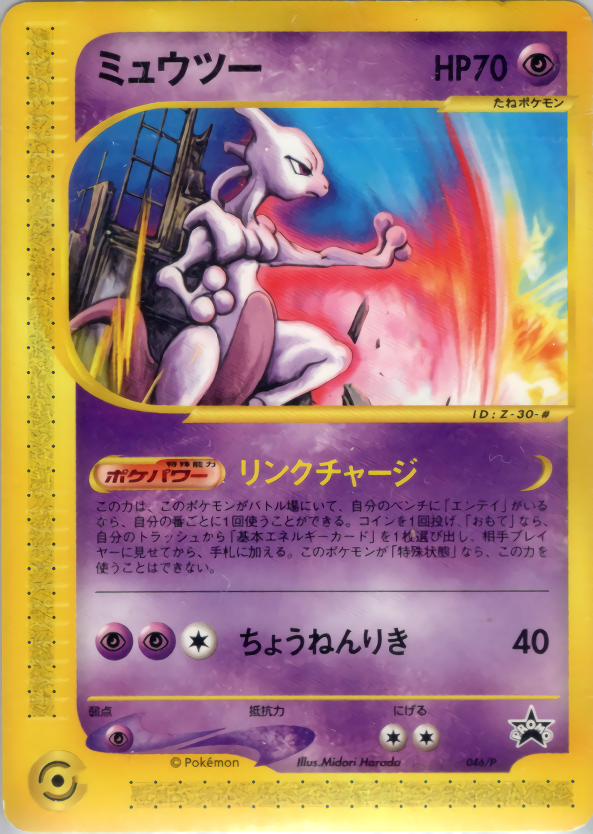
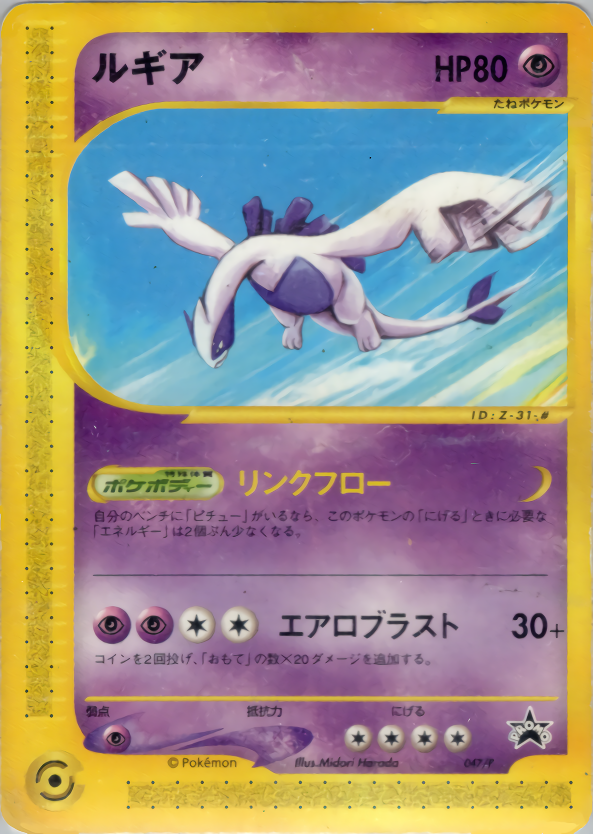
  • Celebi 042/P
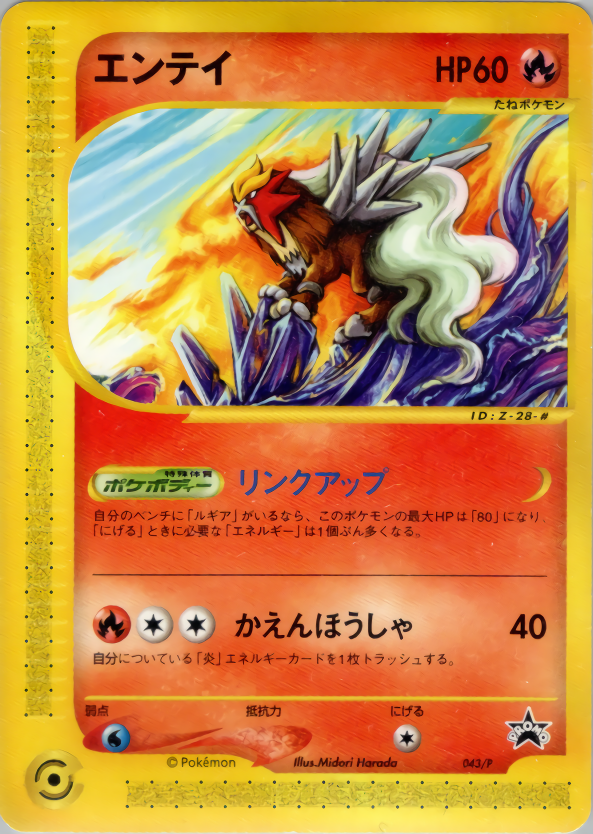
  • Entei 043/P
  • Pikachu 044/P
  • Pichu 045/P
  • Mewtwo 046/P
  • Lugia 047/P
Pokémon Center Tokyo

Round the Yamanote Line · August 2002

Tokotoko Truck

JR East’s rally that summer gave out six e-Cards at stations round Tokyo’s loop line and at the Pokémon Center, all drawn by Midori Harada so their pictures run together. Five of them, all but Mewtwo, play a game in which two Pichu ride a hand-pumped trolley past the stations to the Pokémon Center, jumping the boulders on the line.

Misty's PolitoedMisty's CorsolaRoss's Wailmer

At the cinema · July 2002

Big Fruit Strategy!

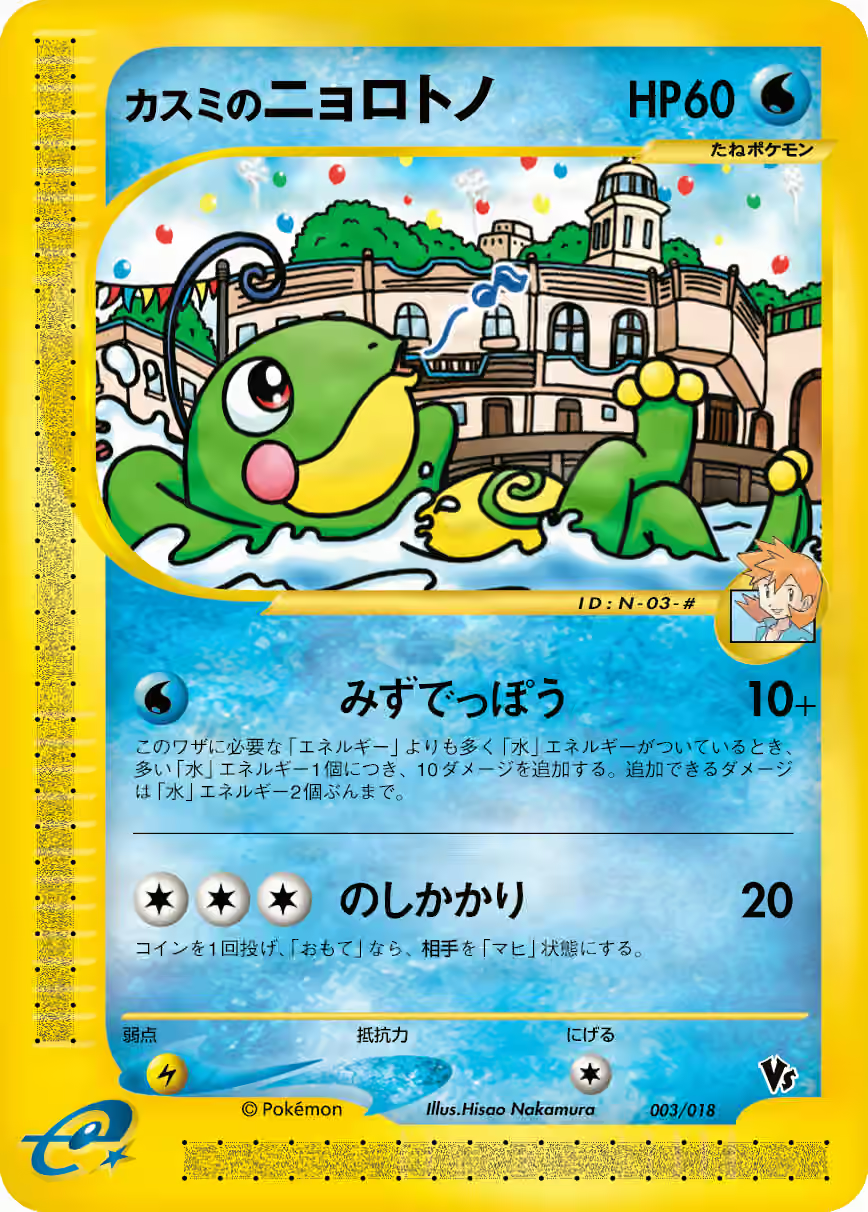
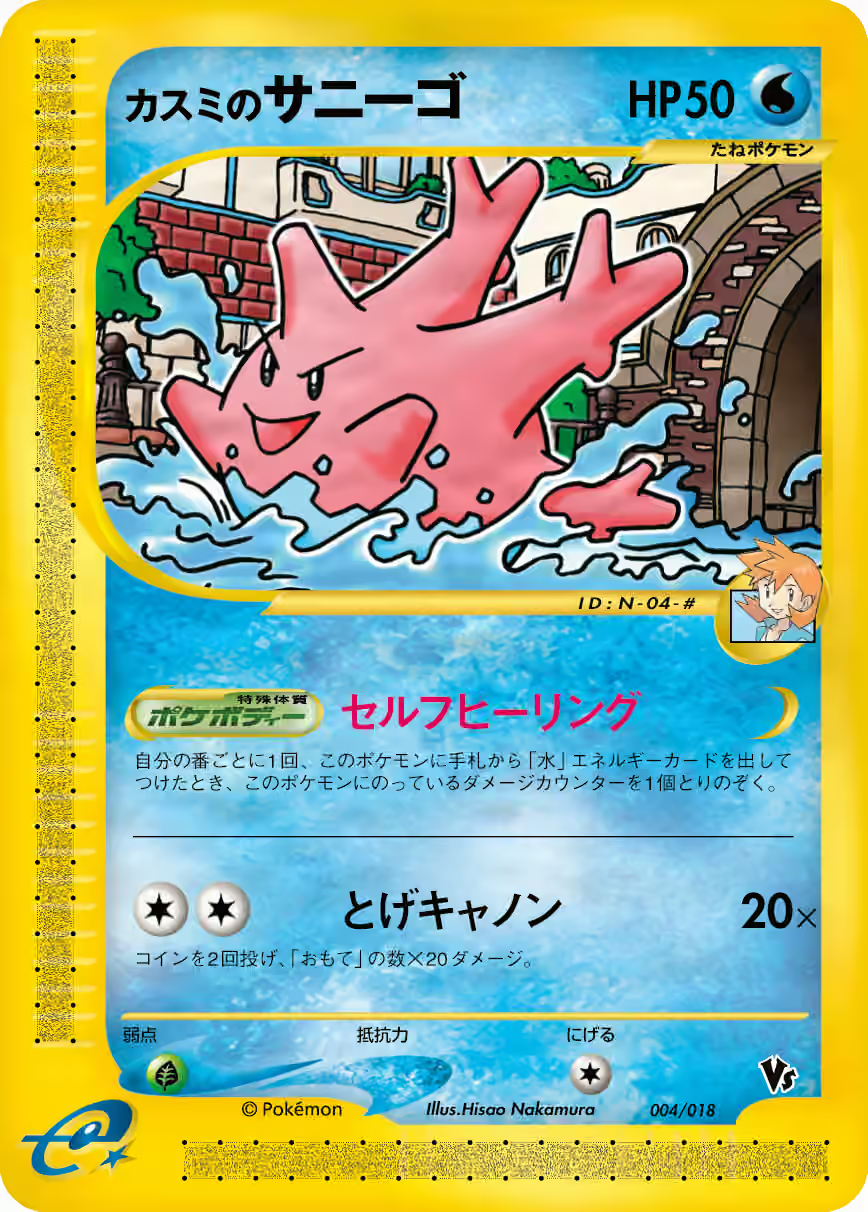
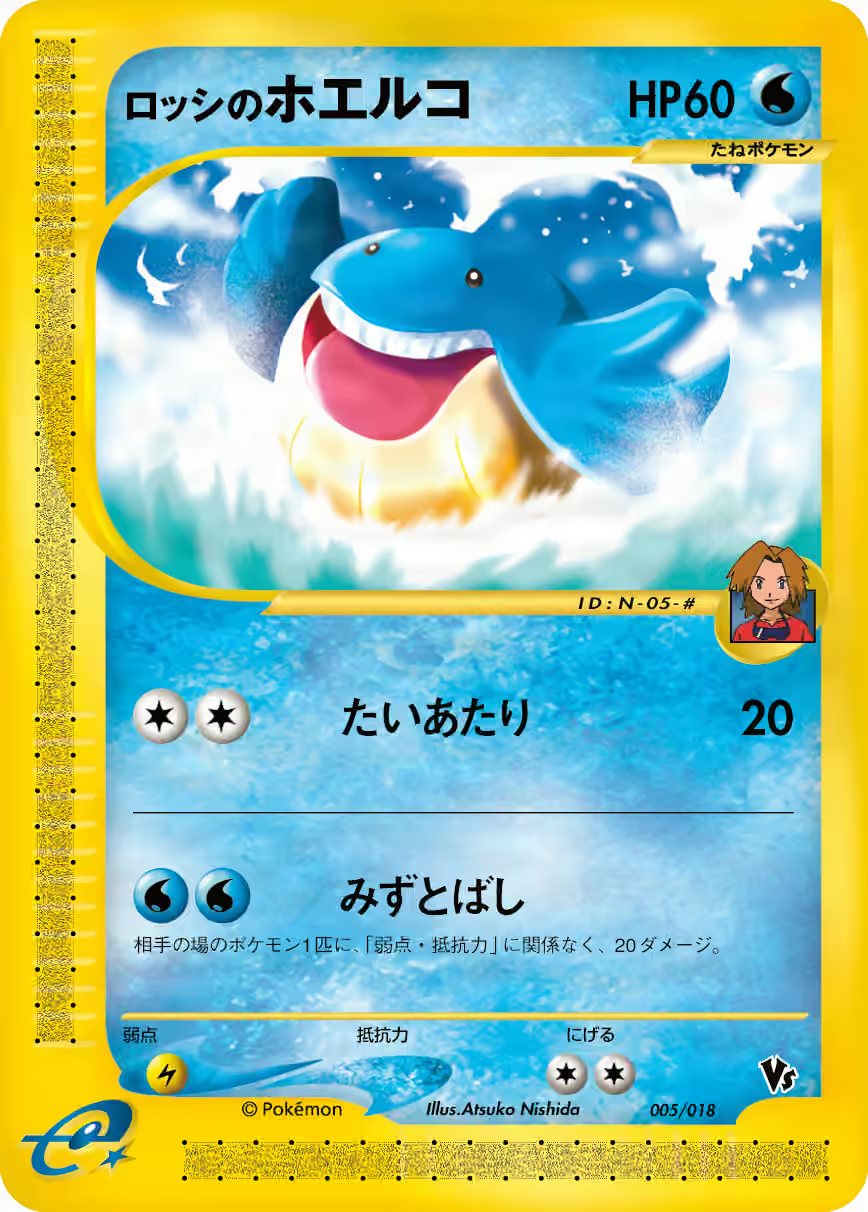
The deck sold with the film that became Pokémon Heroes is the only film deck that works with the reader. Misty’s Politoed, Misty’s Corsola and Ross’s Wailmer play a race in which Totodile swims a hundred meters collecting fruit, from 300-point bananas to 5,000-point watermelons, and dodging Tentacruel.

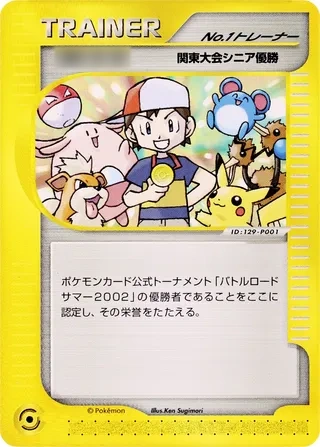
No. 1 Trainer, Battle Road Summer 2002, with the winner’s name blurred

For the champions · summer 2002

A message in the dots

The winners of Battle Road Summer 2002 got a No. 1 Trainer card with their name on it, in the new e-Card frame. Its dots hold a message from Imakuni? for the winner, different for each place. The boy champion’s congratulates him and signs off: “Champion!”

The Japanese reader went on to a second model, the Card e-Reader+, in June 2003, with a cable port to talk to other consoles. Battle e cards put new Trainers to fight in Ruby and Sapphire, new Berries to grow, and later the floors of Trainer Tower in FireRed and LeafGreen, Trainer Hill in Emerald and the Card e Room in Pokémon Colosseum. Only the first Ruby and Sapphire series came out in English; the English FireRed, LeafGreen and Emerald didn’t read e-Cards at all.

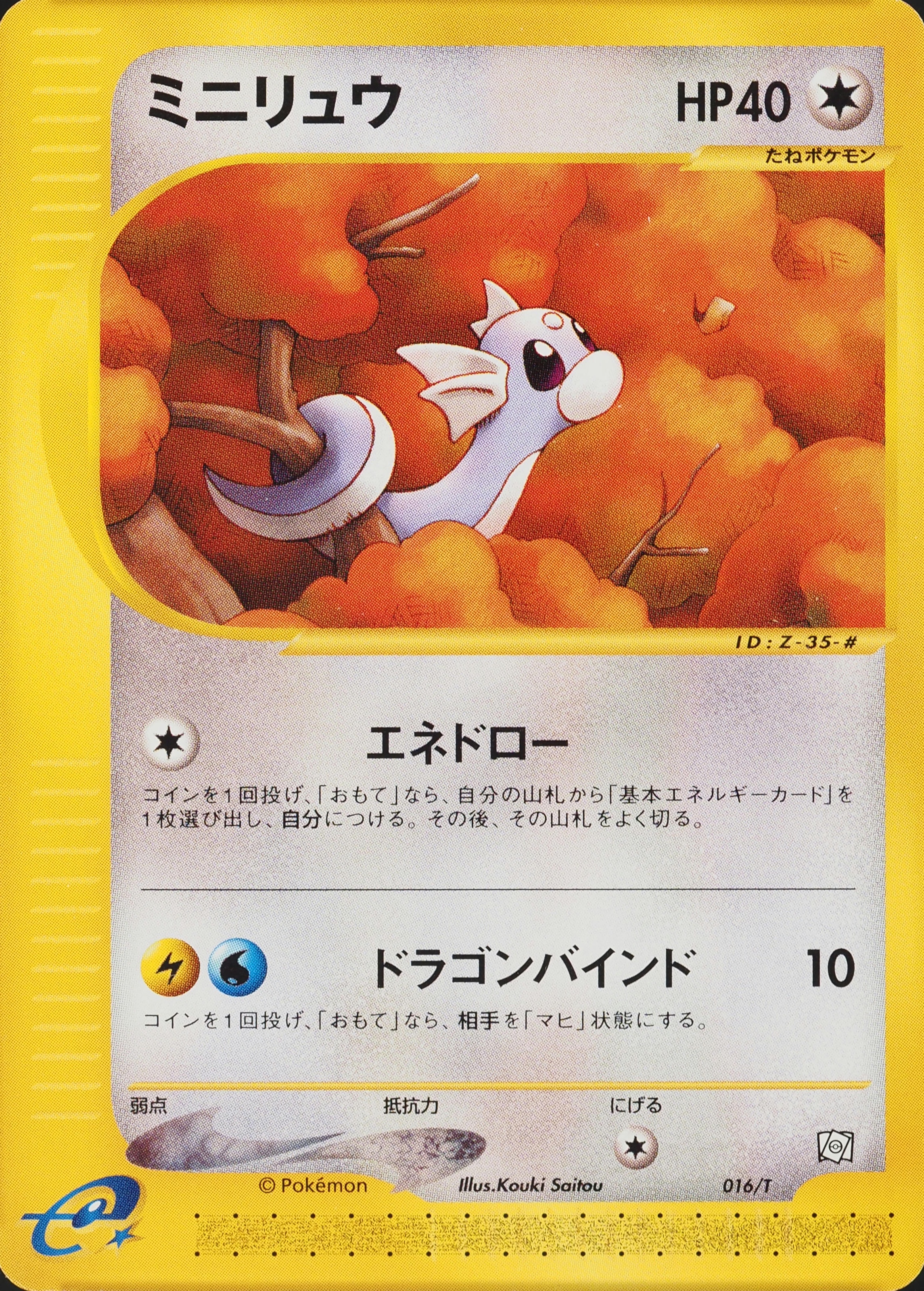
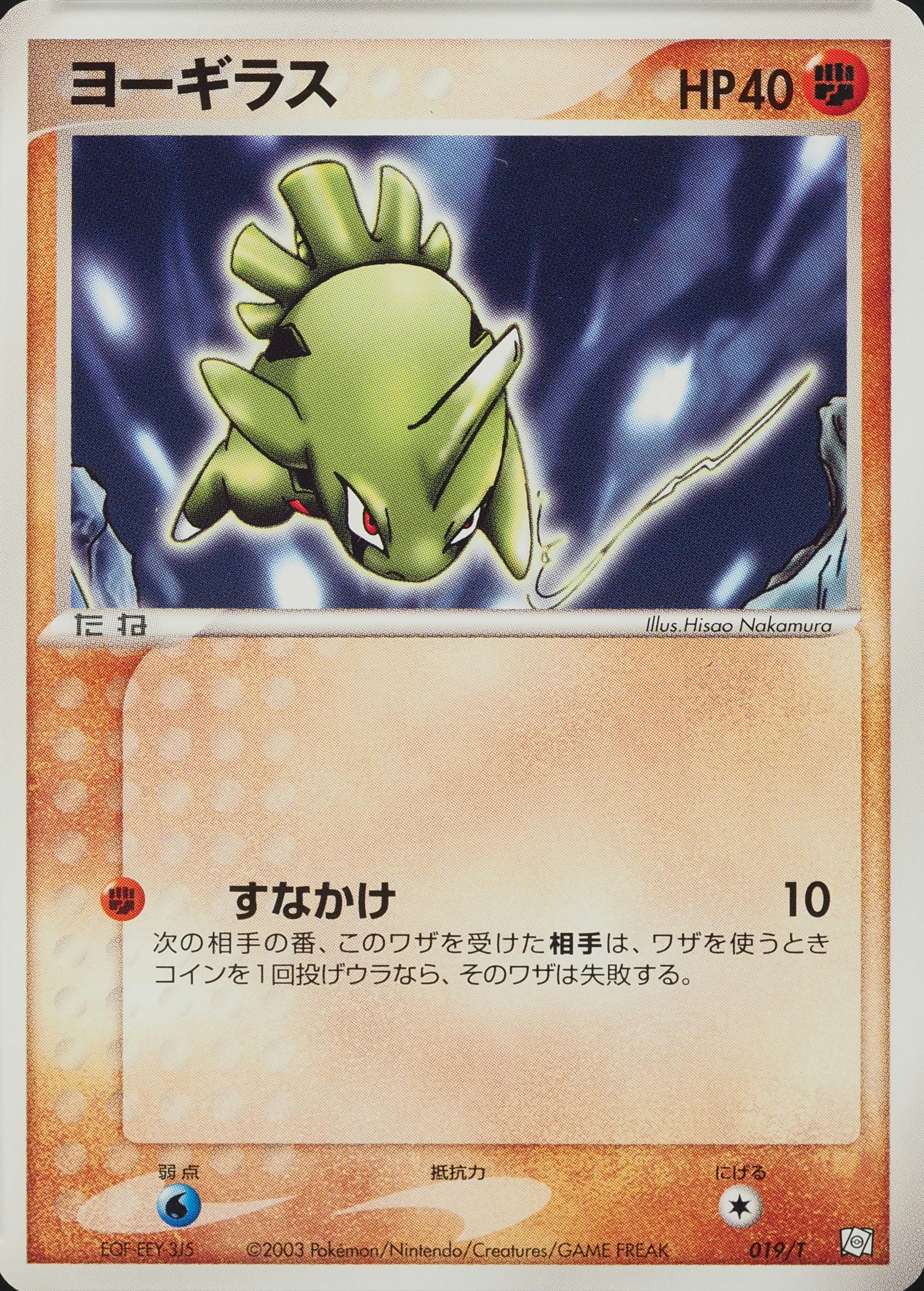
Dratini 016/T, with the e-Reader stripsLarvitar 019/T, from 2003, without them

The magazine promos tell the end in two cards: Dratini, November 2002, with strips; Larvitar, January 2003, without.

ID: CH-09-#さよなら、ドットコード

The dots run out

In Japan the e-Card series ended with its fifth pack in October 2002, and the ADV cards that followed in January 2003 had no dots. English sets went on longer, with less.

  1. Pichu, ExpeditionExpeditionA long strip down the side and a short one along the bottom.
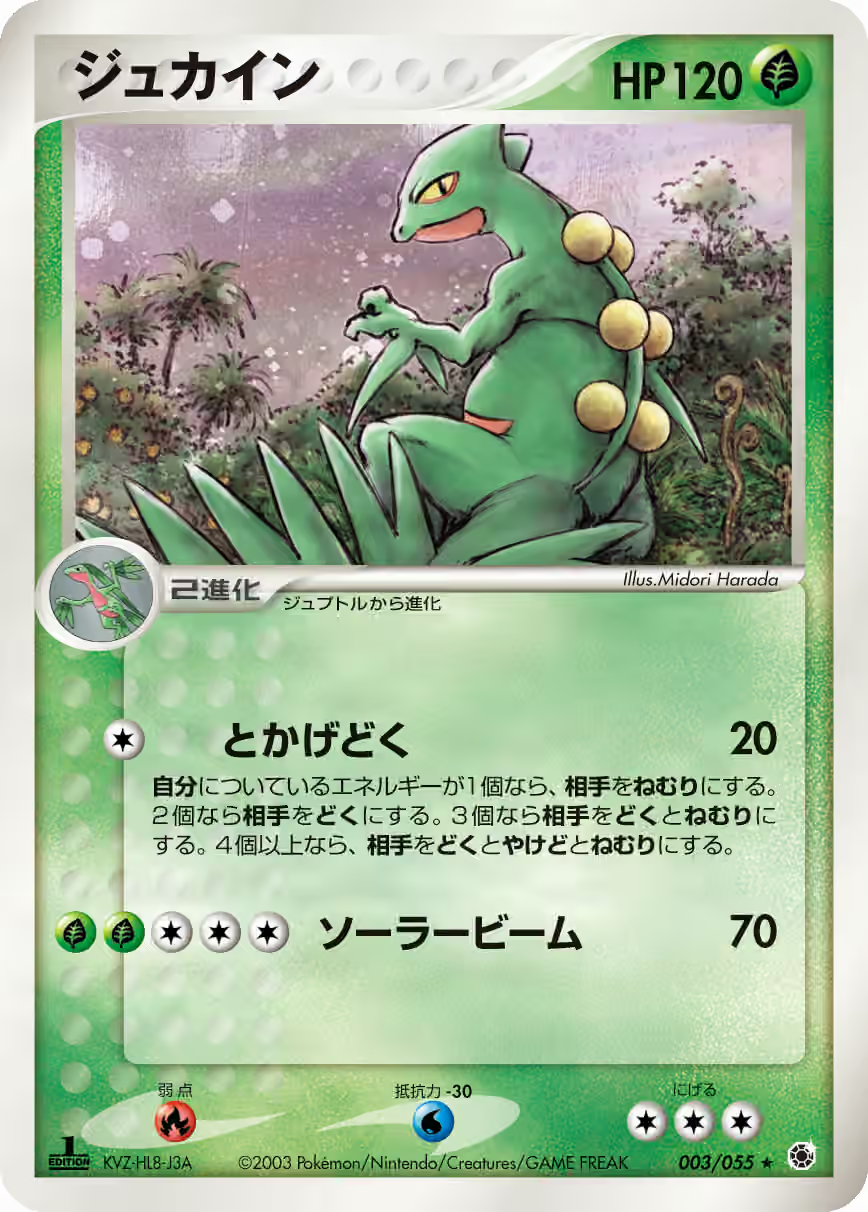
  2. Sceptile, ADV Expansion Pack, JapanADV Expansion Pack, JapanJapan’s new series drops the dots altogether.
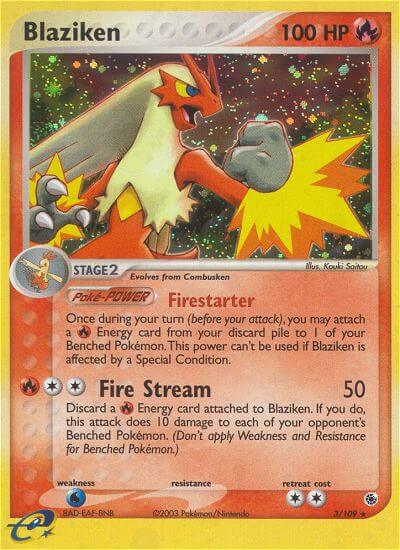
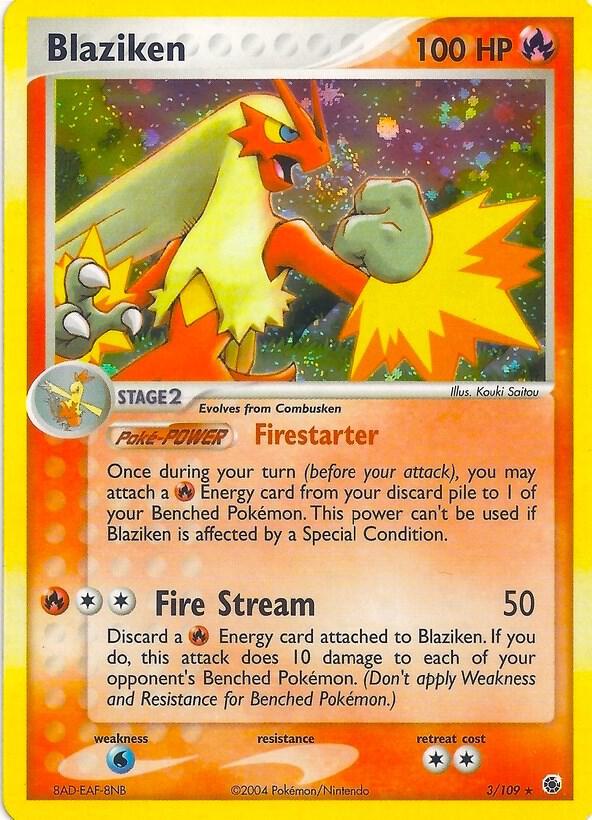
  3. Blaziken, EX Ruby & SapphireEX Ruby & SapphireOne short strip, which tells you where to find the Pokémon in Ruby and Sapphire.
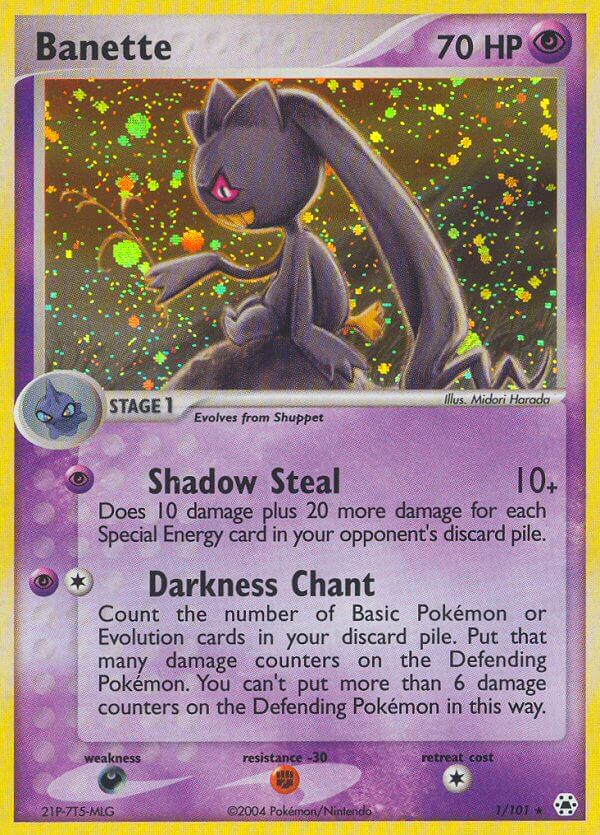
  4. Banette, EX Hidden LegendsEX Hidden LegendsThe first English set without dots, three months after Team Magma vs Team Aqua, the last with them.
  5. Blaziken, EX Battle StadiumEX Battle StadiumThe same Blaziken reprinted, its strip and its e mark gone.

The last English cards with dots came in Team Magma vs Team Aqua in March 2004, the fourth set Pokémon USA published after taking the cards over from Wizards of the Coast. The e-Reader itself was discontinued in North America that year.

Pokémon and Pokémon character names are trademarks of Nintendo, Creatures and GAME FREAK. Card pictures and text © The Pokémon Company, Nintendo, Creatures, GAME FREAK and, for older cards, Wizards of the Coast. PennySleeve is not produced, endorsed, sponsored or supported by, or affiliated with, any of them.