特集 Southern Islands · 1999 & 2001
Wish you were here
はるか南の海に、ポケモンたちの楽園を発見!!“Far away in the southern sea, a paradise of Pokémon discovered!!”, the line on the 1999 binders
In the summer of 1999 two painters each filled an island with Pokémon, and their six paintings were cut into eighteen cards. We put every card back where it was cut from, to see what each one kept, what it left behind, and what changed when the cards reached English two summers later.
A paradise in eighteen pieces
Every Southern Islands card is a window onto a bigger picture. Keiko Fukuyama painted three scenes of Rainbow Island and Naoyo Kimura three of Tropical Island, and each scene was cut into three cards, one of them a holo. Lay a scene’s three cards side by side and its picture comes back. Not all of it, though.
We matched every card to its painting, detail by detail, which places it to within a pixel. Scroll through each scene and its cards lift out of the spots they were cut from, and the Pokémon they left behind are named once they’re out.
To everyone
on Rainbow Island & Tropical Island,
far away in the southern sea
18 cards6 scenes2 islands2 painters
南の島 Summer 1999
The summer Pokémon went south
In Japan, 1999 was a year in the islands. From January to October the cartoon followed Ash and Pikachu through the Orange Islands, a chain of tropical islands south of Kanto, and one May episode was simply called “It’s a southern island! Everyone assemble!”. The second film, Revelation Lugia, opened on 17 July and was set there too, on an island whose shrine is kept by a Slowking who talks.
The card game got islands of its own the same day. The Pokémon Company’s card archive still files Southern Islands under the film, as its 映画公開記念パック, the pack that marked its opening. Each scene came as a set of three cards, and each island as a folder of nine.
Four cards with no number
Four of the eighteen came from games that weren’t out yet. Togepi, Marill, Ledyba and Slowking belong to Gold and Silver, which reached Japanese shops on 21 November 1999, four months after the cards, and every one of them is a holo.
The cards give it away themselves. At the foot of each one, opposite the painter’s name, the fourteen older Pokémon print their Pokédex number, from Ivysaur’s No. 002 to Mew’s No. 151. The four new ones leave the space blank: their numbers hadn’t been announced.
切り抜き Six postcards
Back where they were cut from
Scroll through each scene to lift its three cards out of the painting.
レインボーアイランド
Rainbow Island
Painted by Keiko Fukuyama
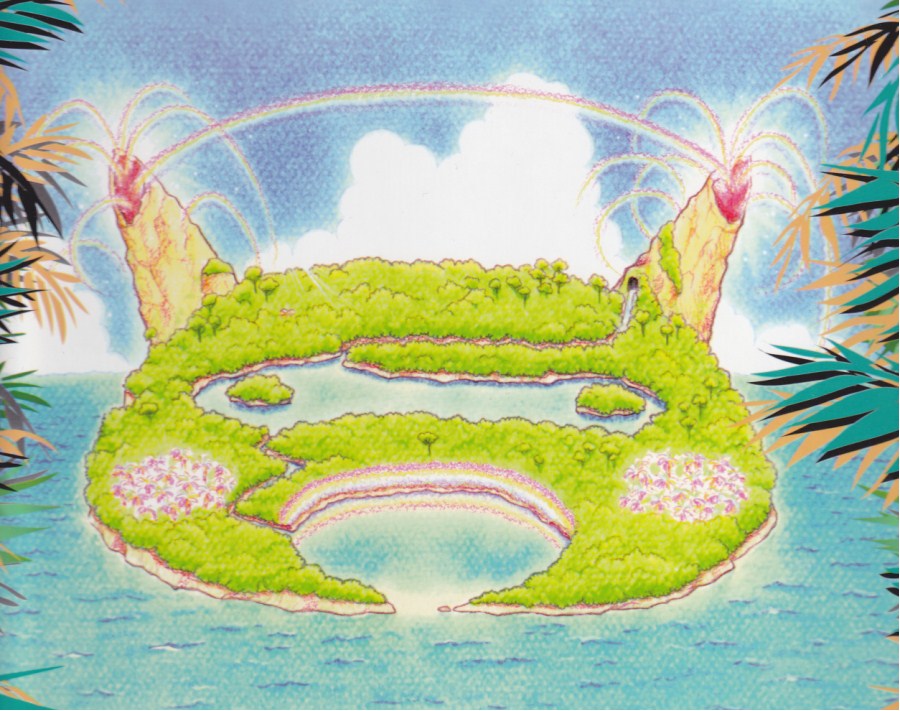
A ring of meadow round a lagoon, with a volcano at each end throwing sparks and rainbows over the sea. Fukuyama’s scenes were cut with the windows crowded together and overlapping, so each of her three puts 38 to 48% of its painting on the cards.
1 Sky2 Riverside3 Field of Flowers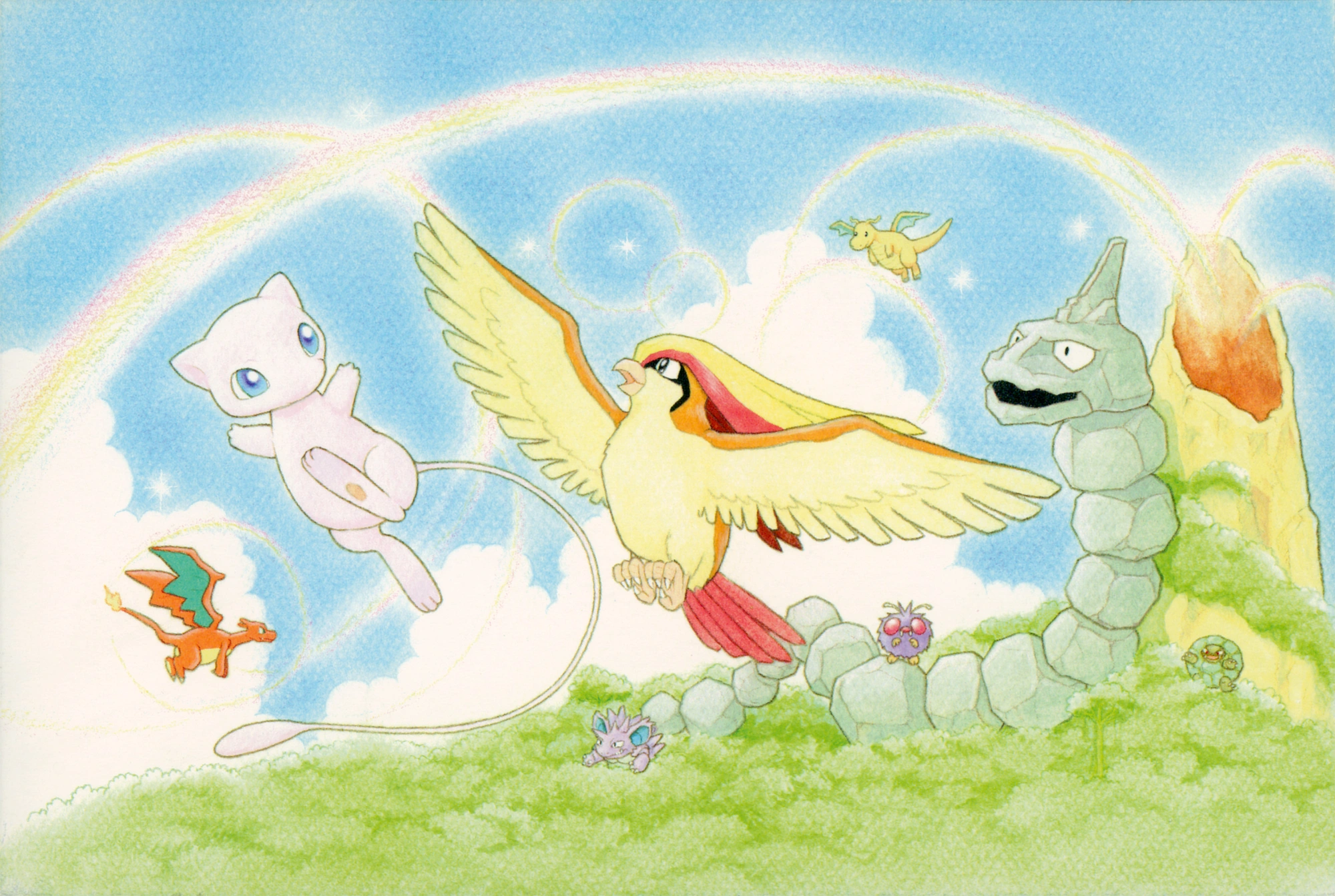
- Charizard
- Dragonite
- Venonat
- Nidoran♂
- Golem
Sky
Keiko Fukuyama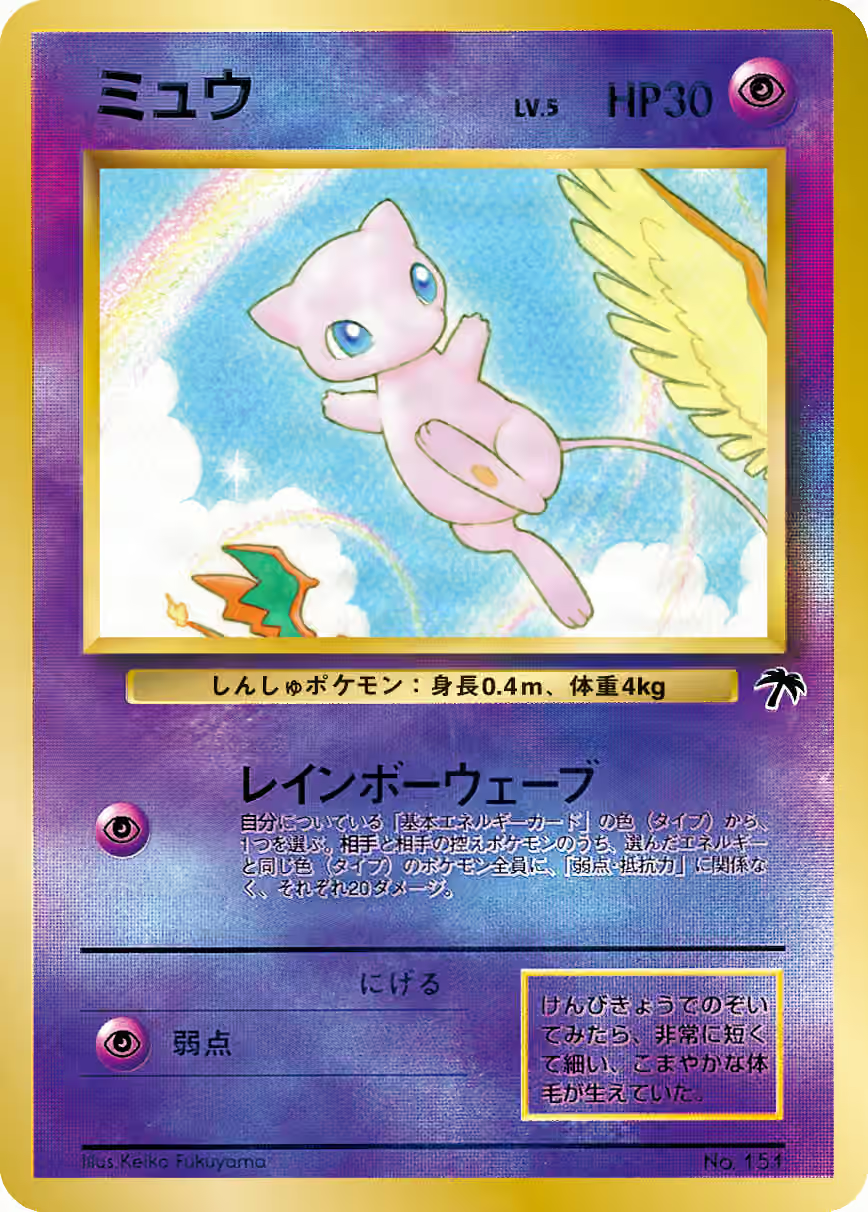
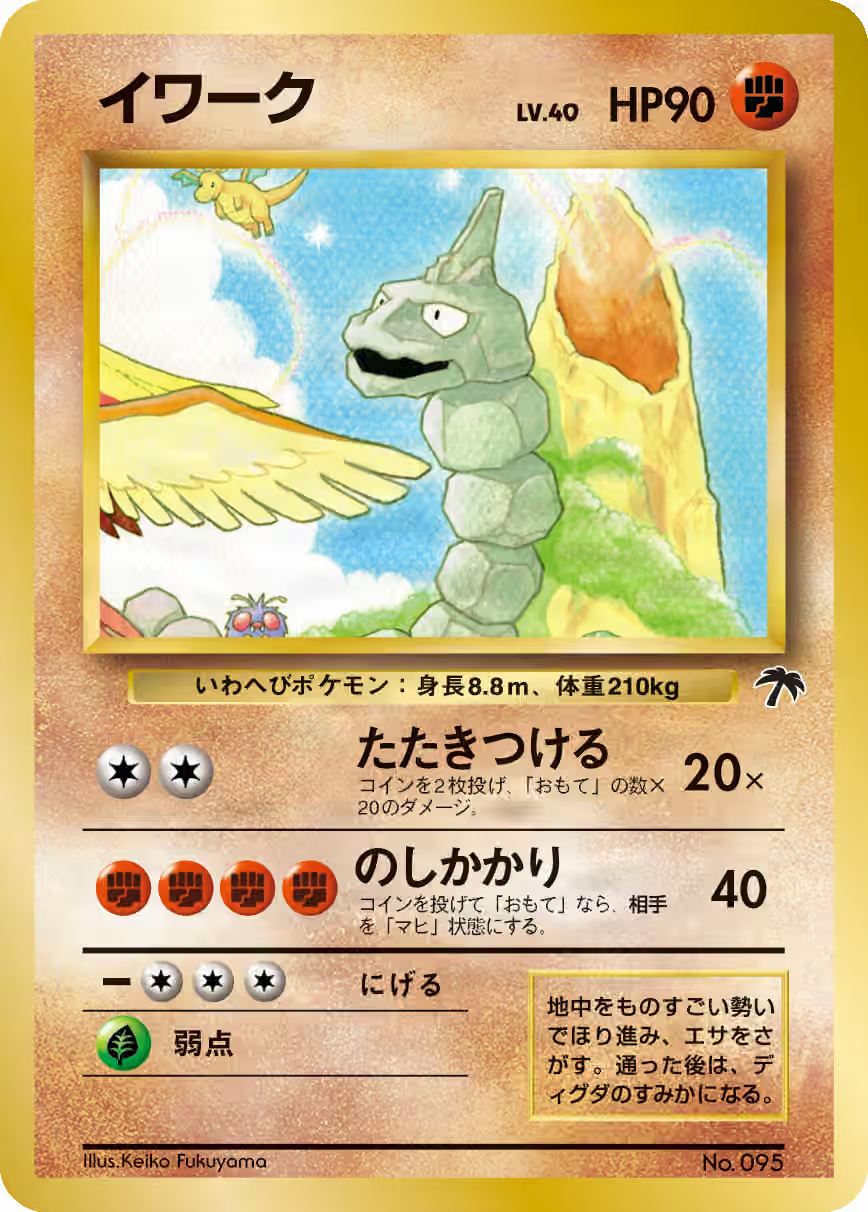
46% of the painting made it onto the cards
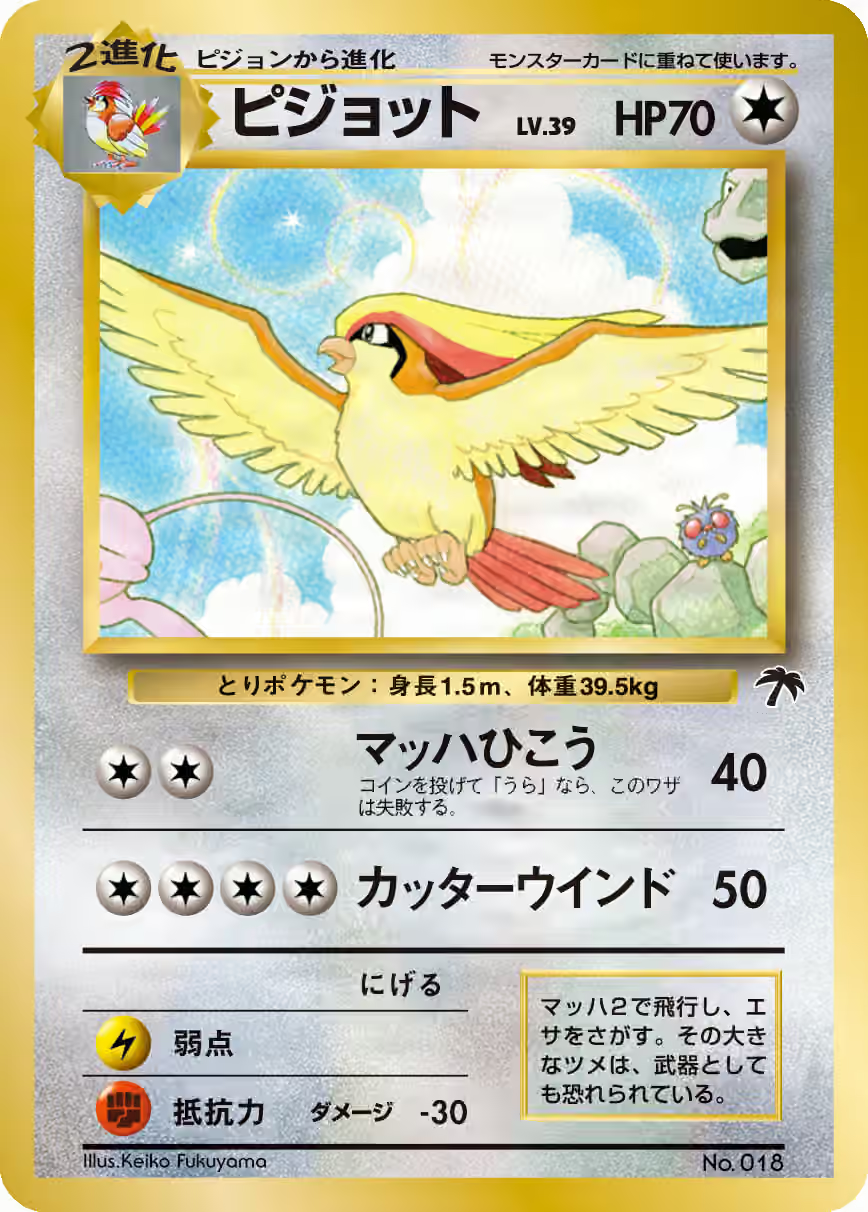
Mew tumbles through Fukuyama’s rainbows, Pidgeot spreads its wings across the middle of the picture and Onix rises out of the hill like a wall. Pidgeot’s card is cut at a slant, so that both wings fit, and it overlaps both its neighbors: a third of Mew’s picture is on Pidgeot’s card too.
Also here, without a card: Charizard, Dragonite, Venonat, Nidoran♂, Golem.
- Wartortle
- Pikachu
- Goldeen
- Slowpoke
- Weedle
Riverside
Keiko Fukuyama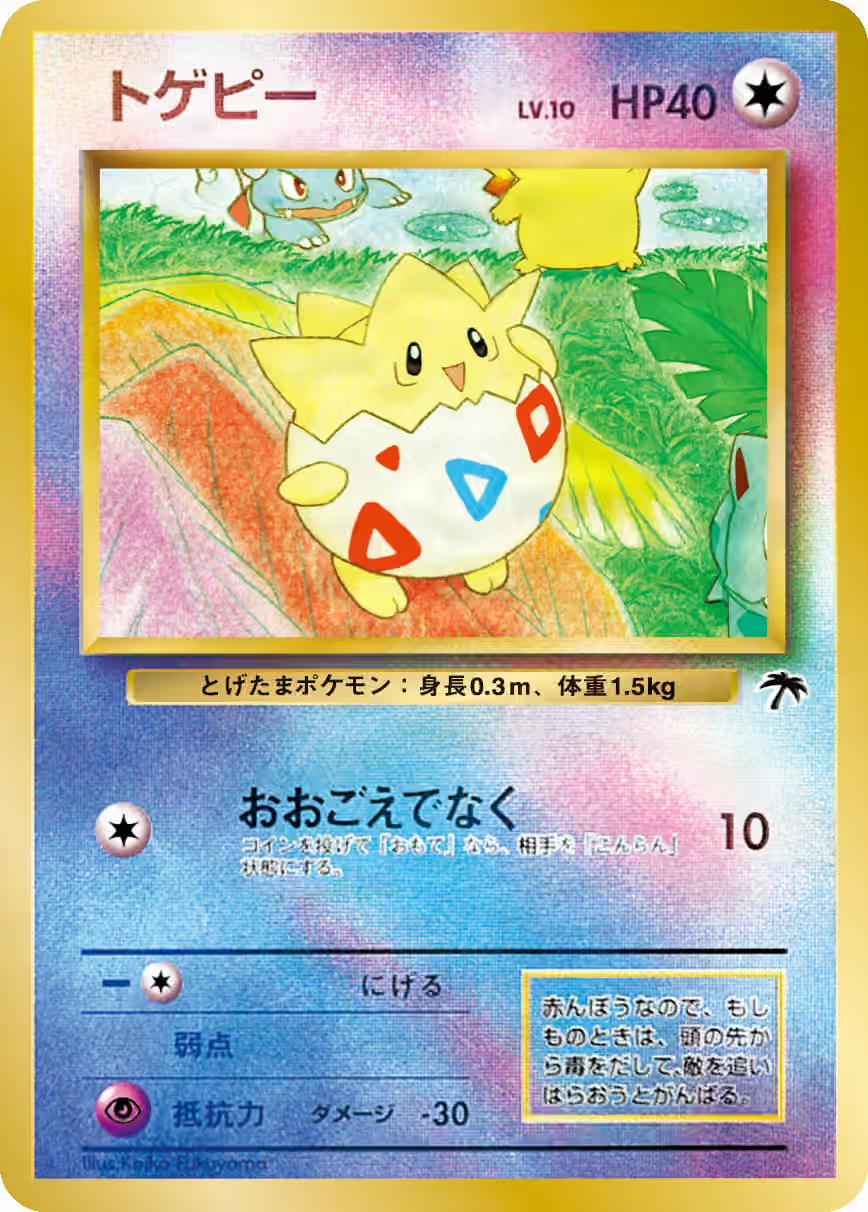
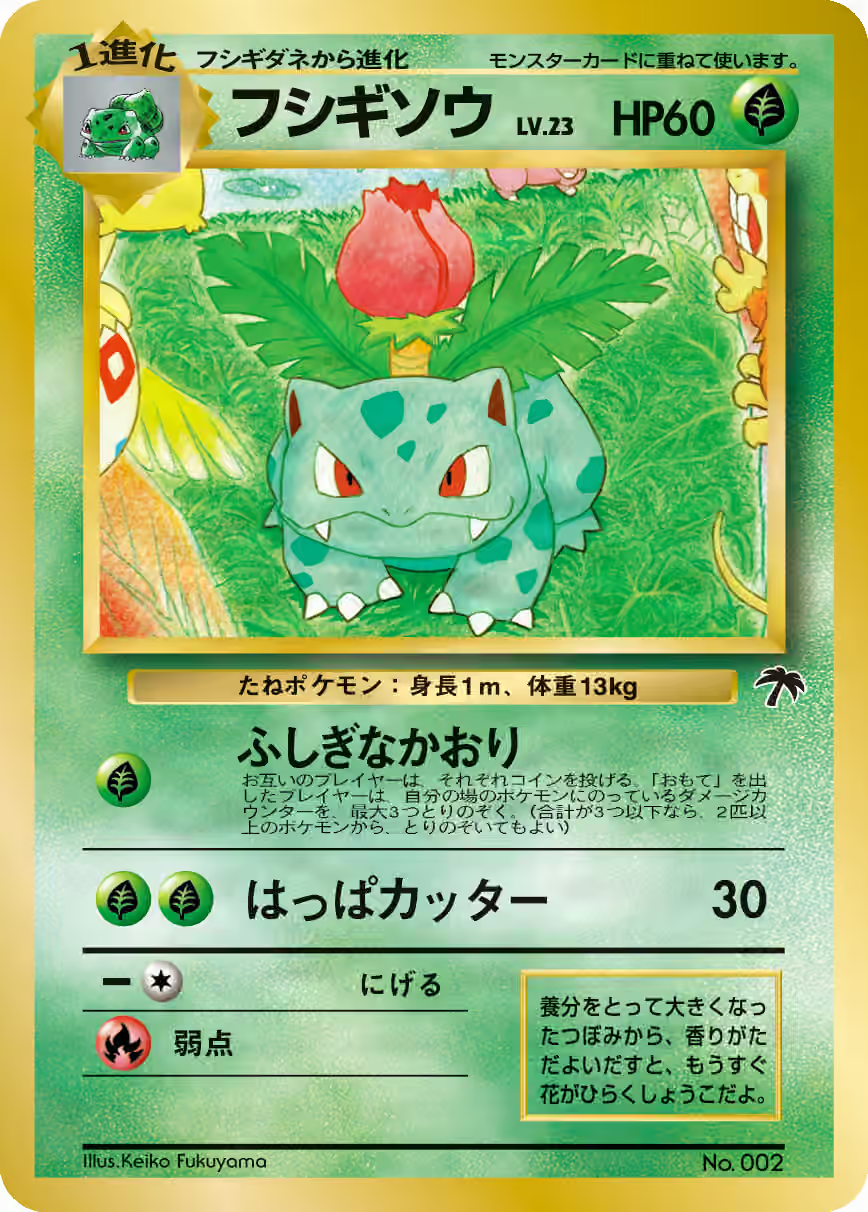
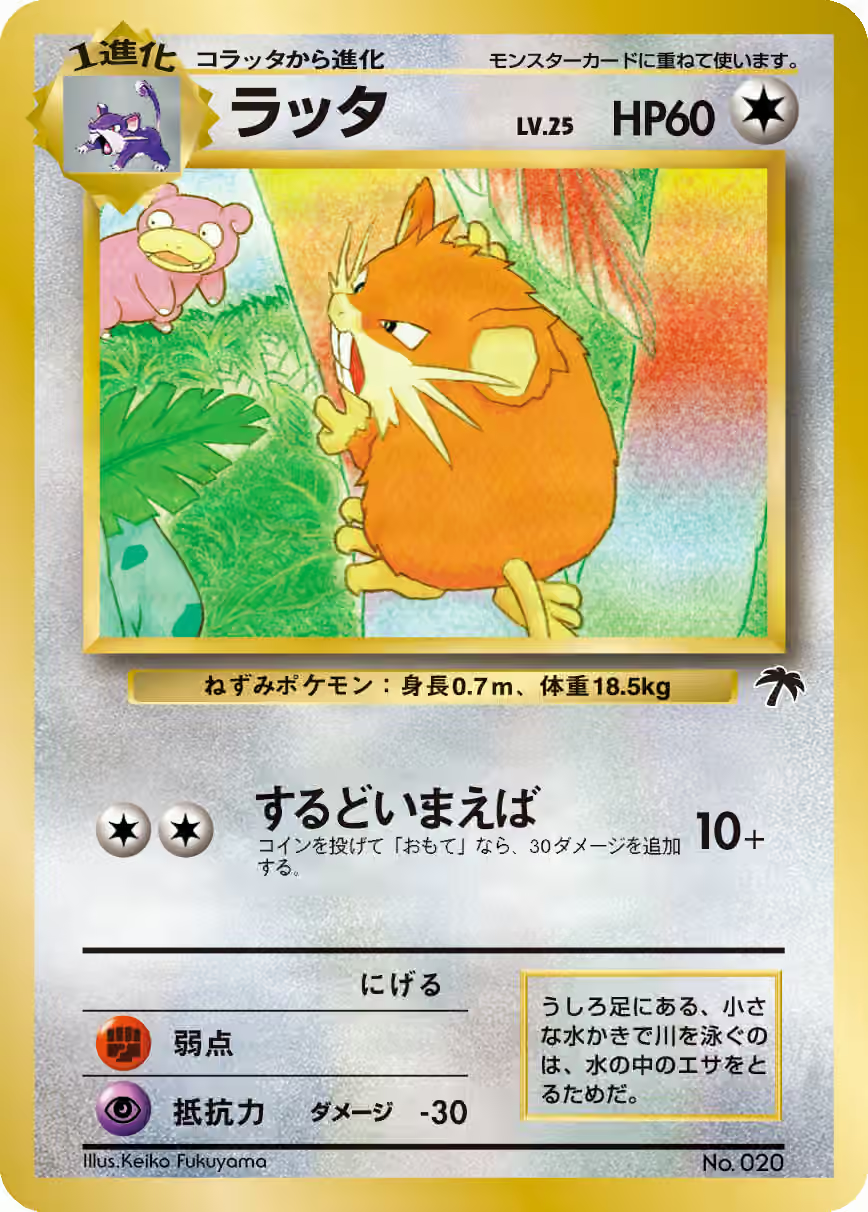
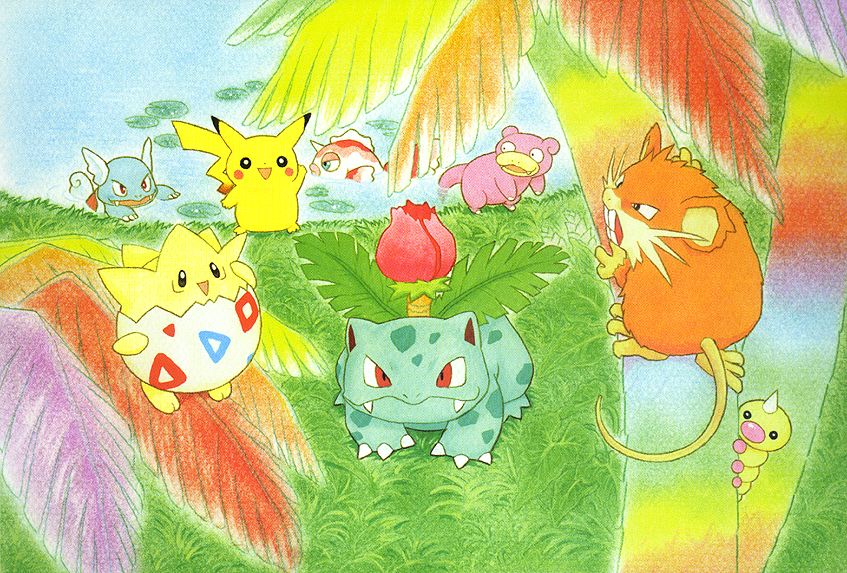
48% of the painting made it onto the cards
Under leaves striped like rainbows, Togepi peeps out of its shell, Ivysaur stands its ground and Raticate clings to a trunk. Pikachu is in Southern Islands after all: it is watching from the far bank, beside a Goldeen, with no card of its own.
Also here, without a card: Wartortle, Pikachu, Goldeen, Slowpoke, Weedle.
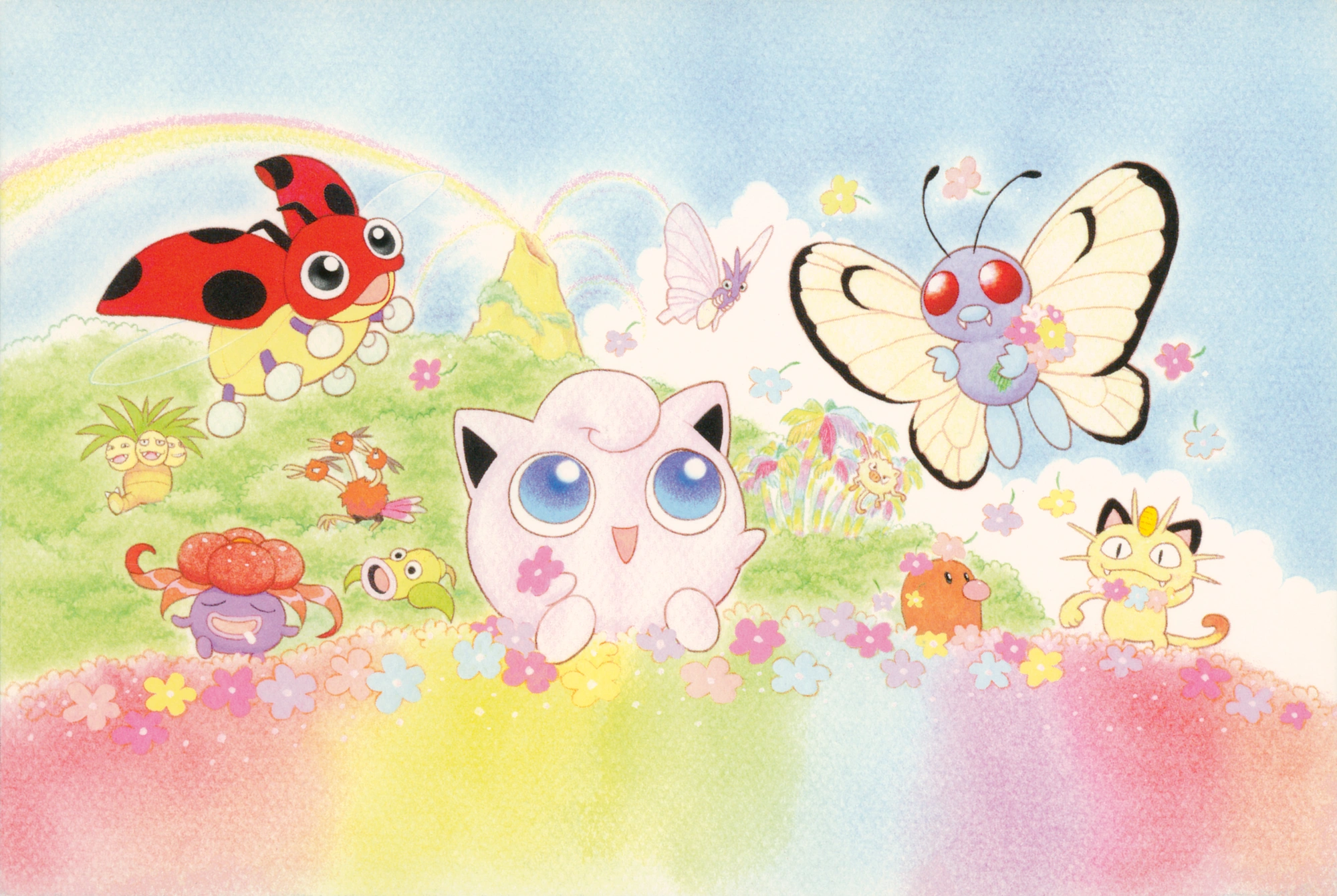
- Exeggutor
- Dodrio
- Gloom
- Weepinbell
- Venomoth
- Mankey
- Diglett
- Meowth
Field of Flowers
Keiko Fukuyama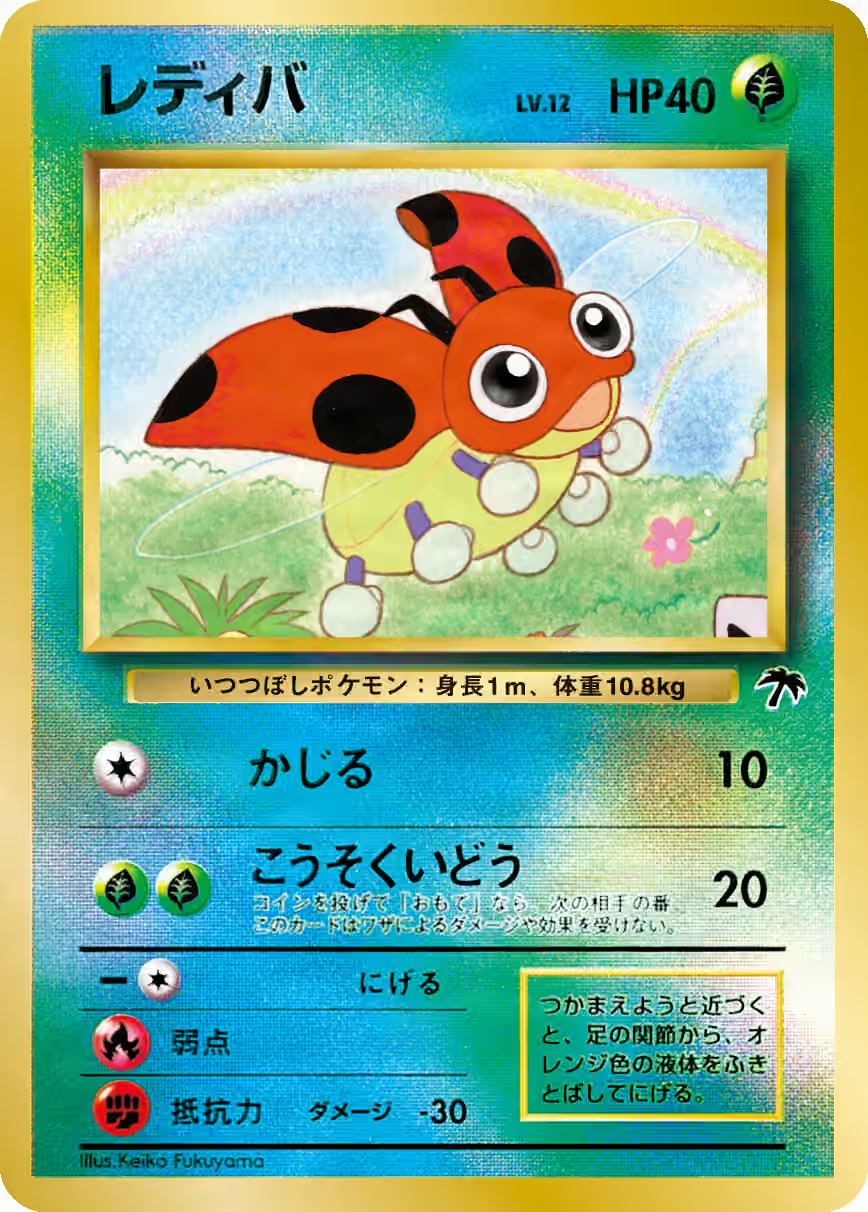
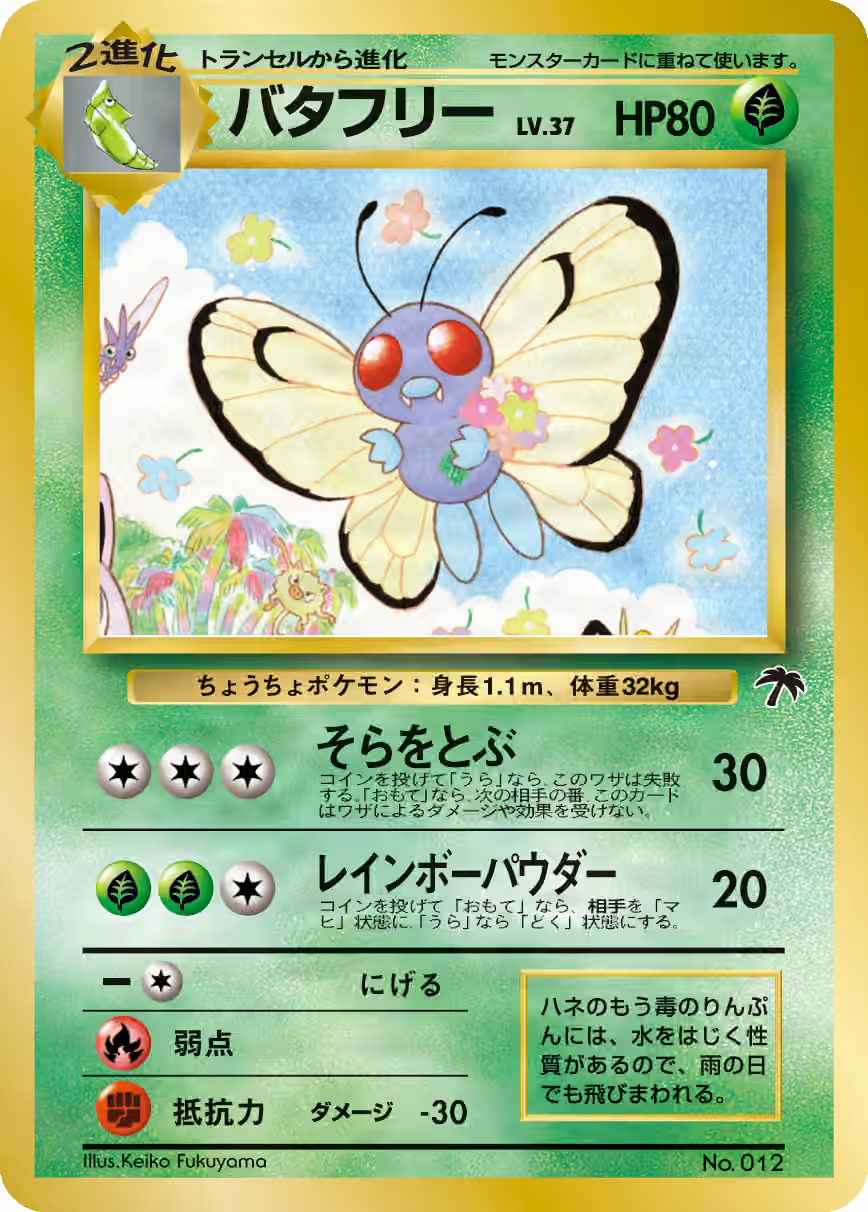
38% of the painting made it onto the cards
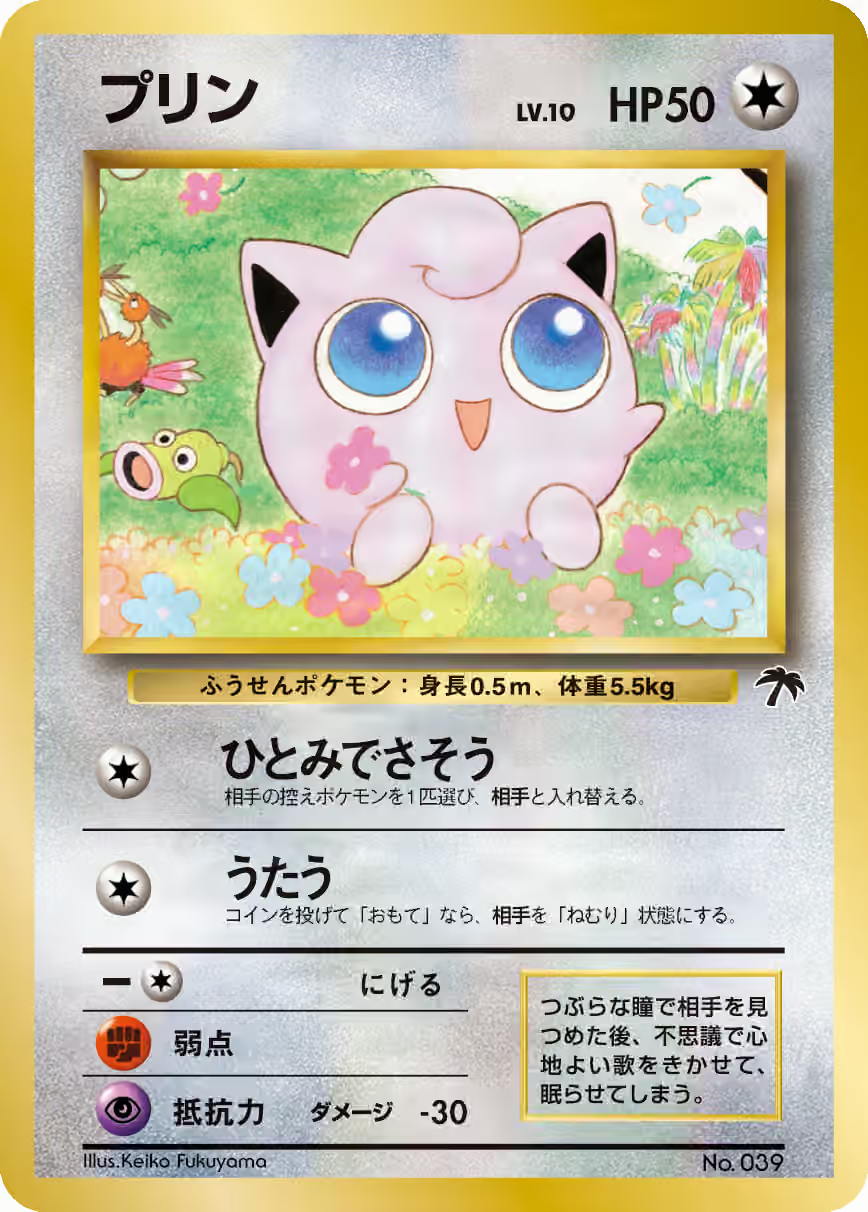
Jigglypuff sits in a bed of flowers, Ledyba flies in from the left and Butterfree carries a bouquet. Half the island seems to have turned up: look for Meowth with a garland and Diglett in the flowers.
Also here, without a card: Exeggutor, Dodrio, Gloom, Weepinbell, Venomoth, Mankey, Diglett, Meowth.
トロピカルアイランド
Tropical Island
Painted by Naoyo Kimura
Jungle and golden cliffs, with a white beach curling round one end. Kimura’s windows barely touch, so each of her scenes puts only 27 to 30% of itself on the cards: most of her island, its cliffs and palms and plenty of its Pokémon, never reached a card at all.
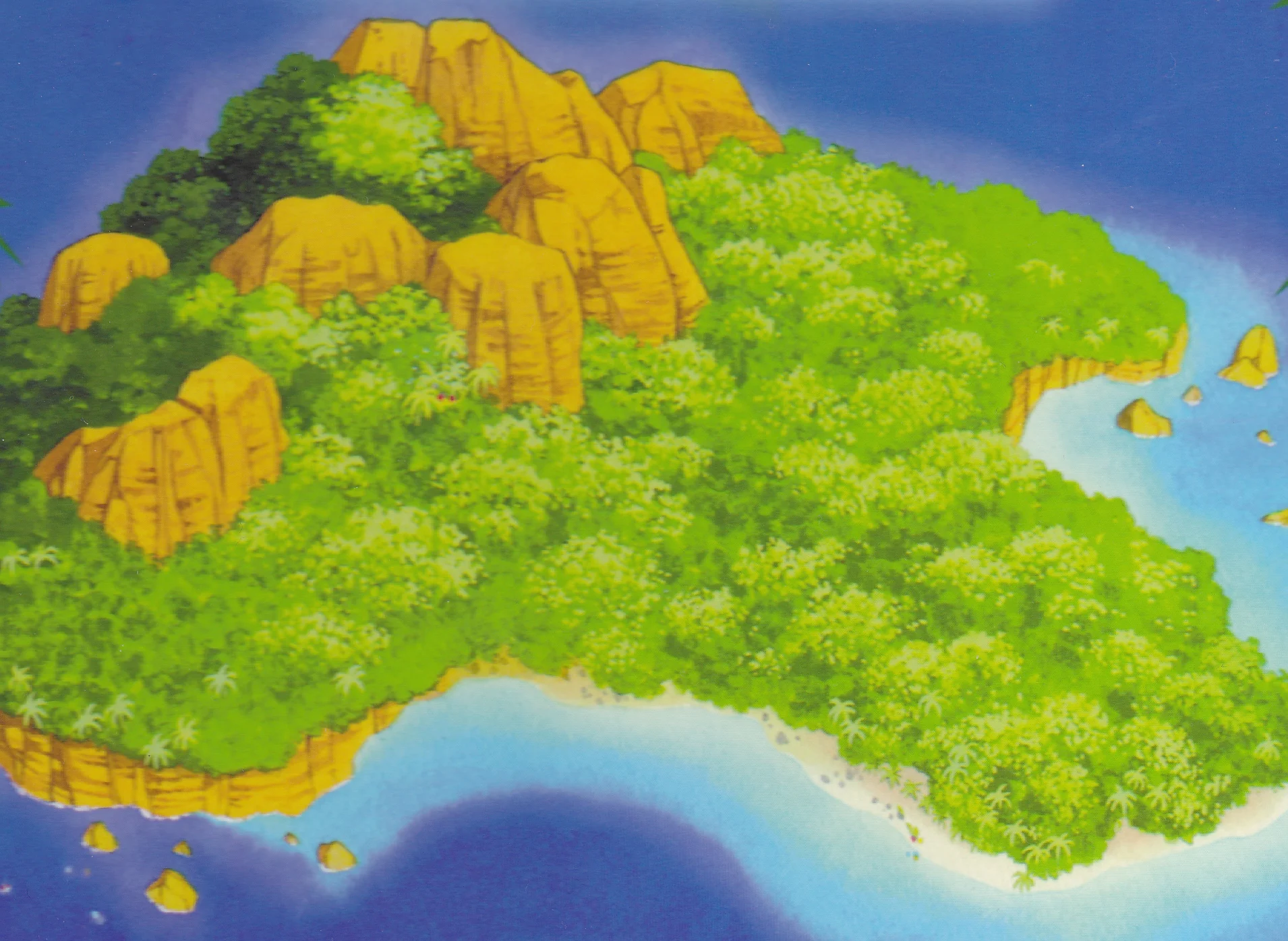 1 Jungle2 Beach3 Sea
- Rattata
- Weepinbell
- Venonat
- Venomoth
- Oddish
- Caterpie
- Paras
Jungle
Naoyo Kimura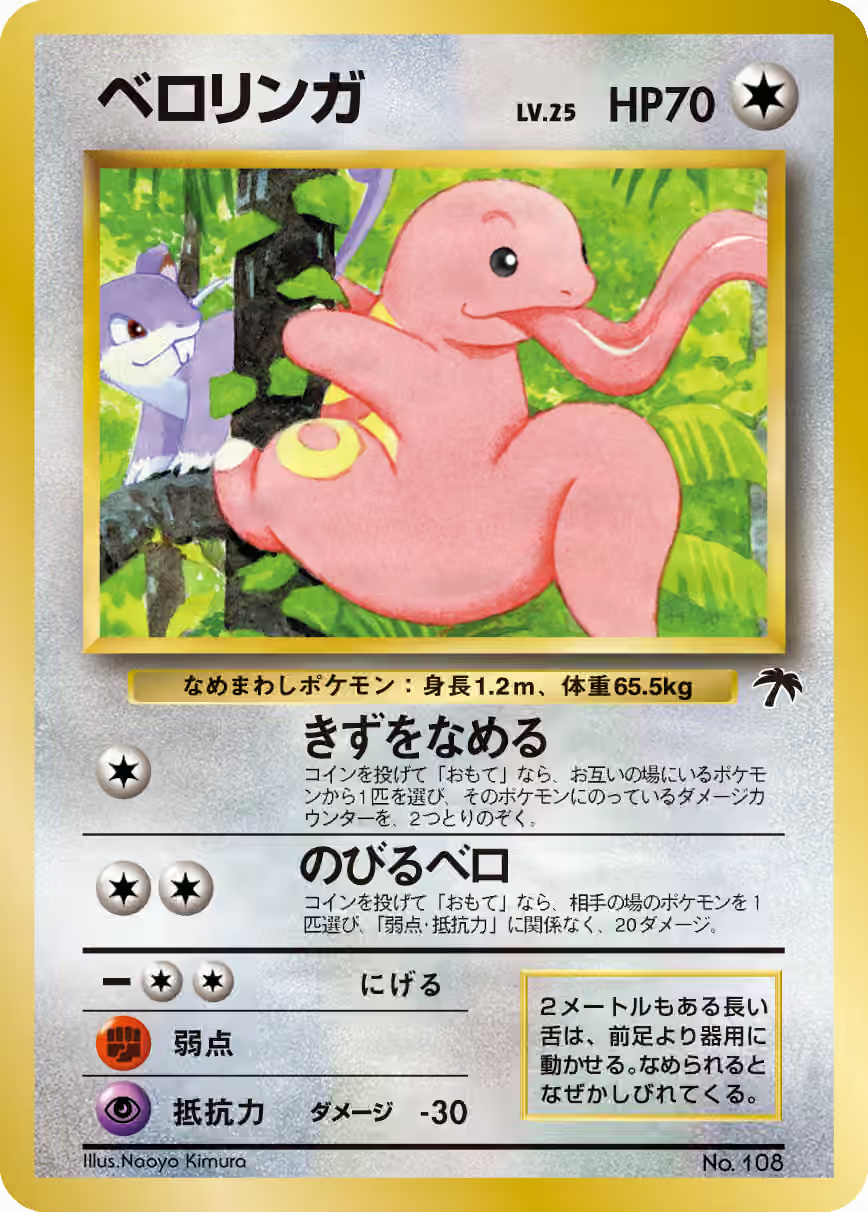
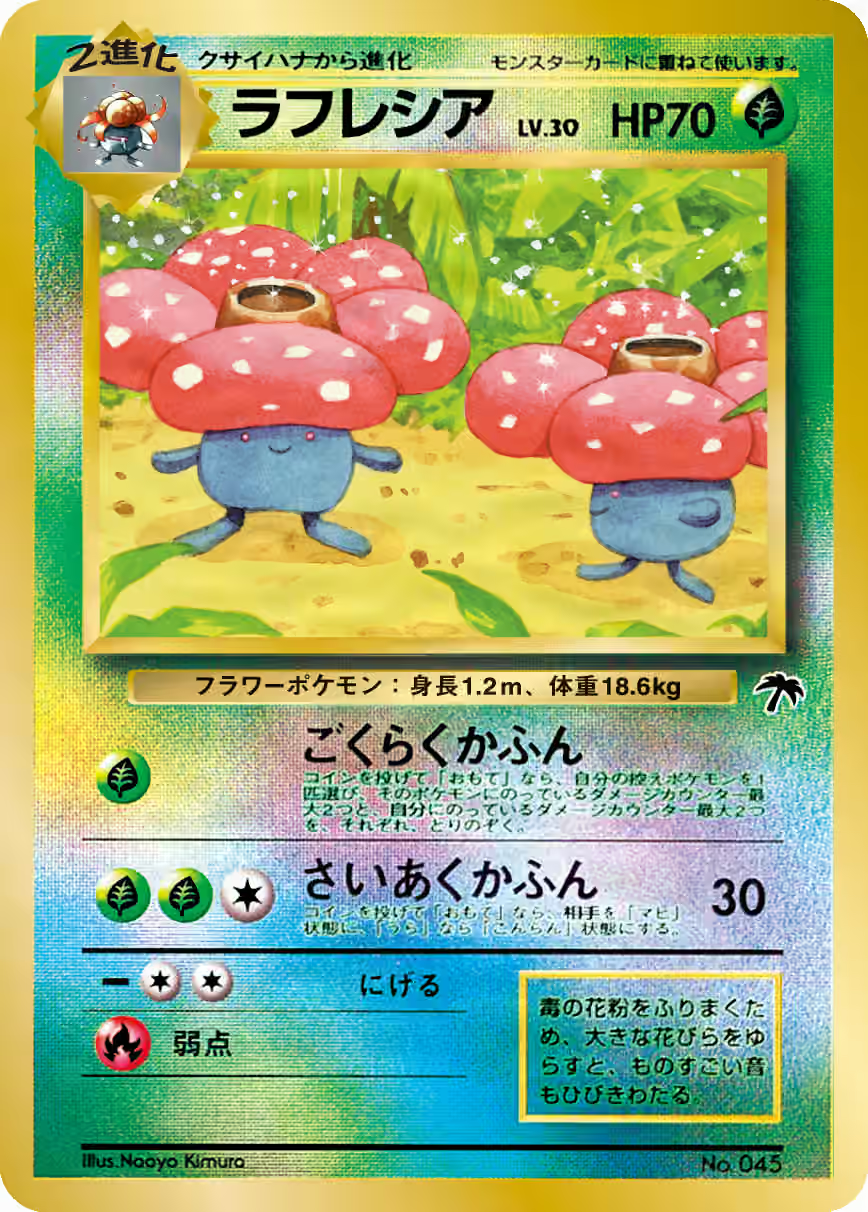
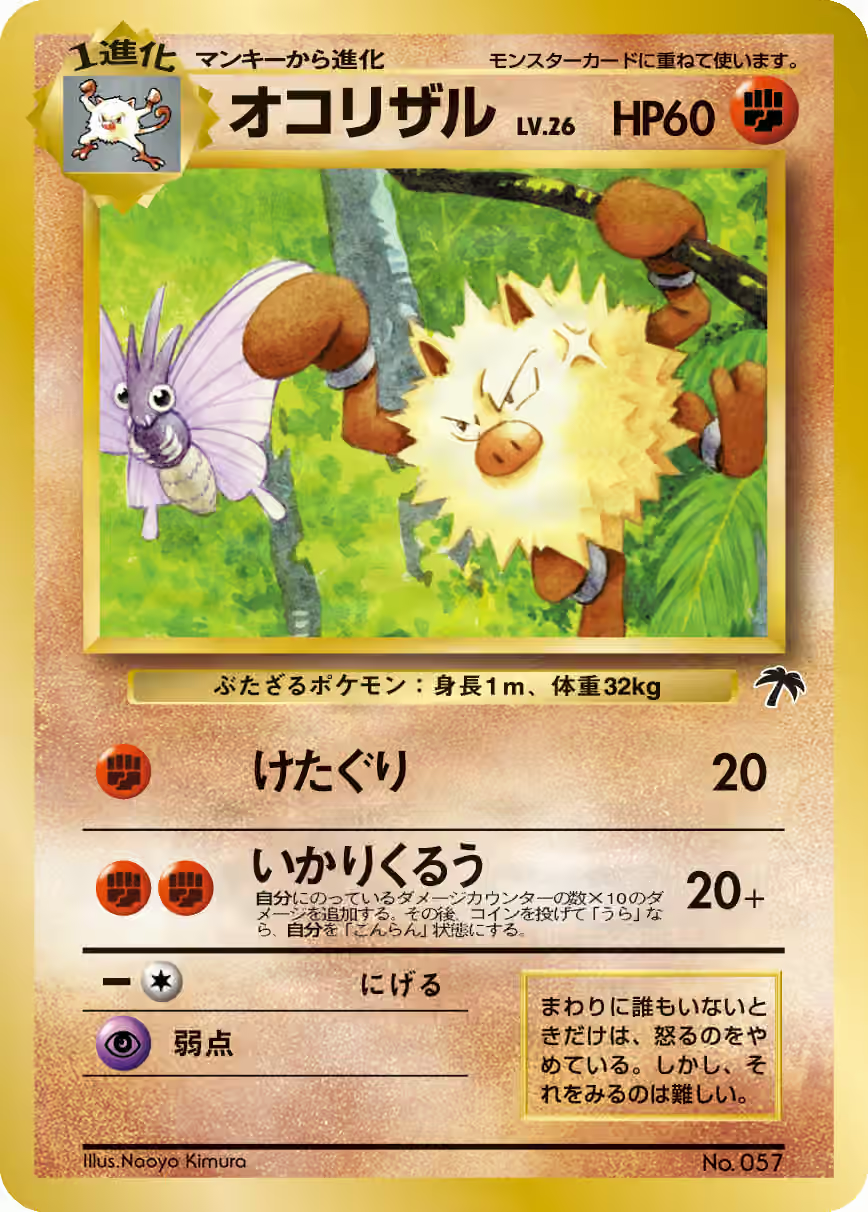
27% of the painting made it onto the cards
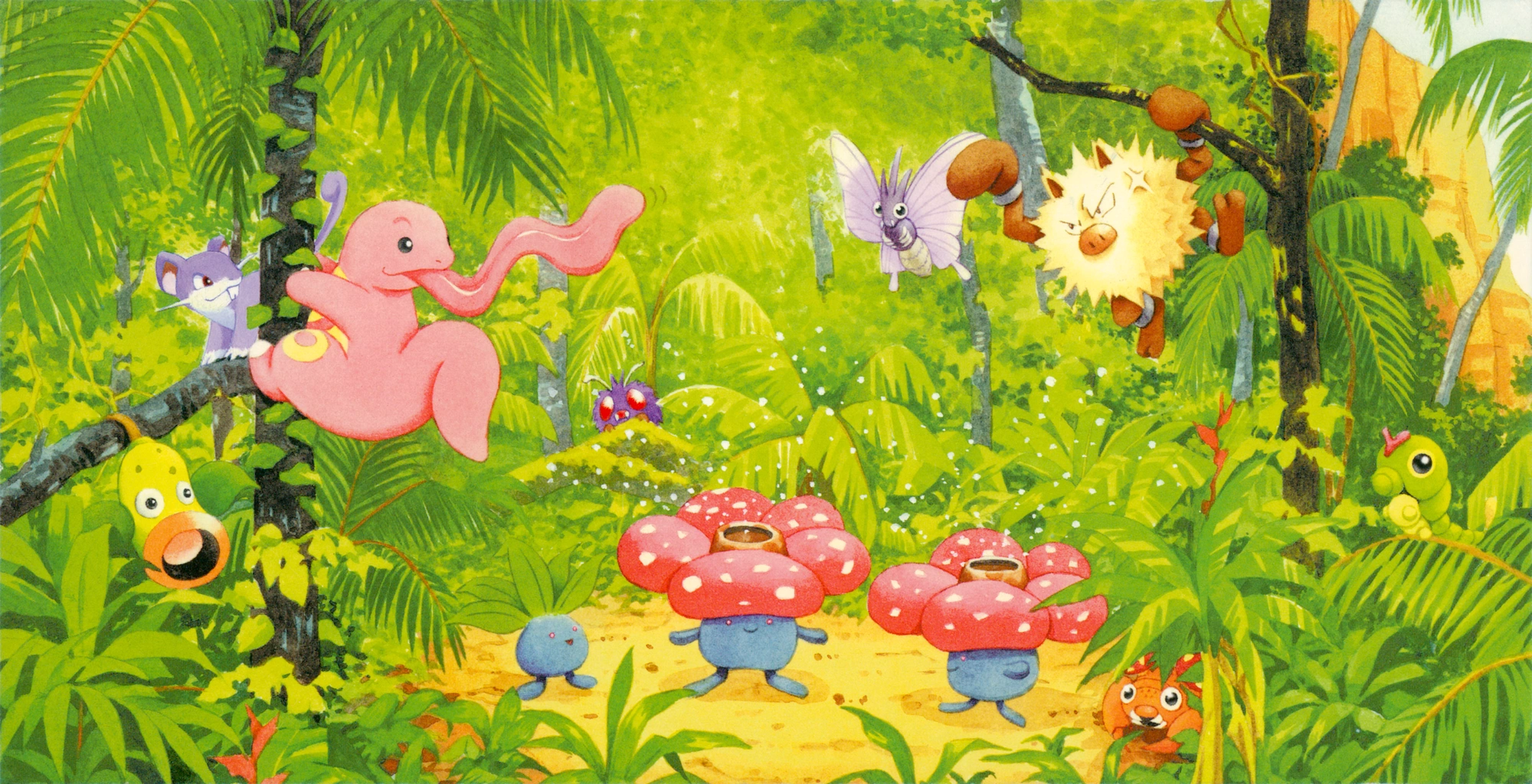
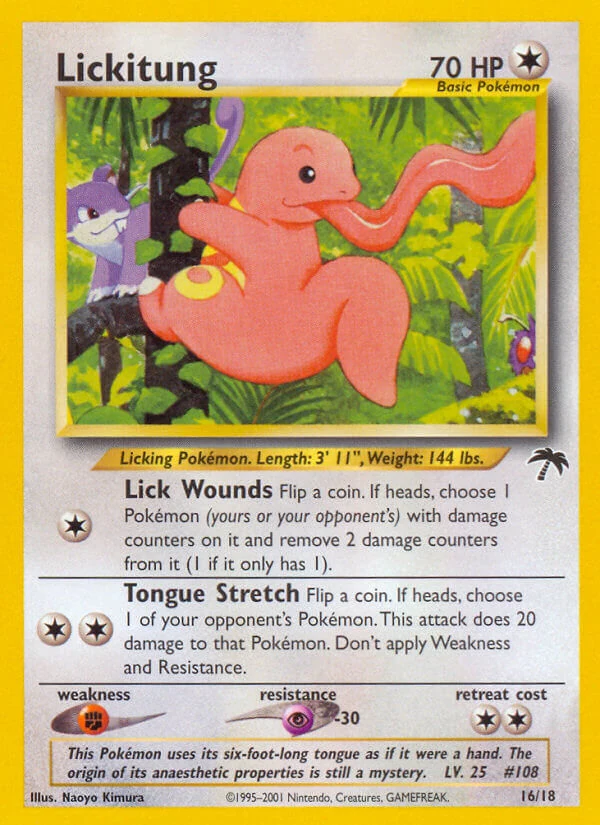
Kimura’s jungle is dense and green and full of hiding places. Lickitung hangs off a branch by its tongue, Primeape swings through the trees and two Vileplume stand side by side on the path, both of them on the holo card. The three cards don’t share a speck of painting.
Also here, without a card: Rattata, Weepinbell, Venonat, Venomoth, Oddish, Caterpie, Paras.
- Poliwhirl
- Bellsprout
- Psyduck
- Horsea
Beach
Naoyo Kimura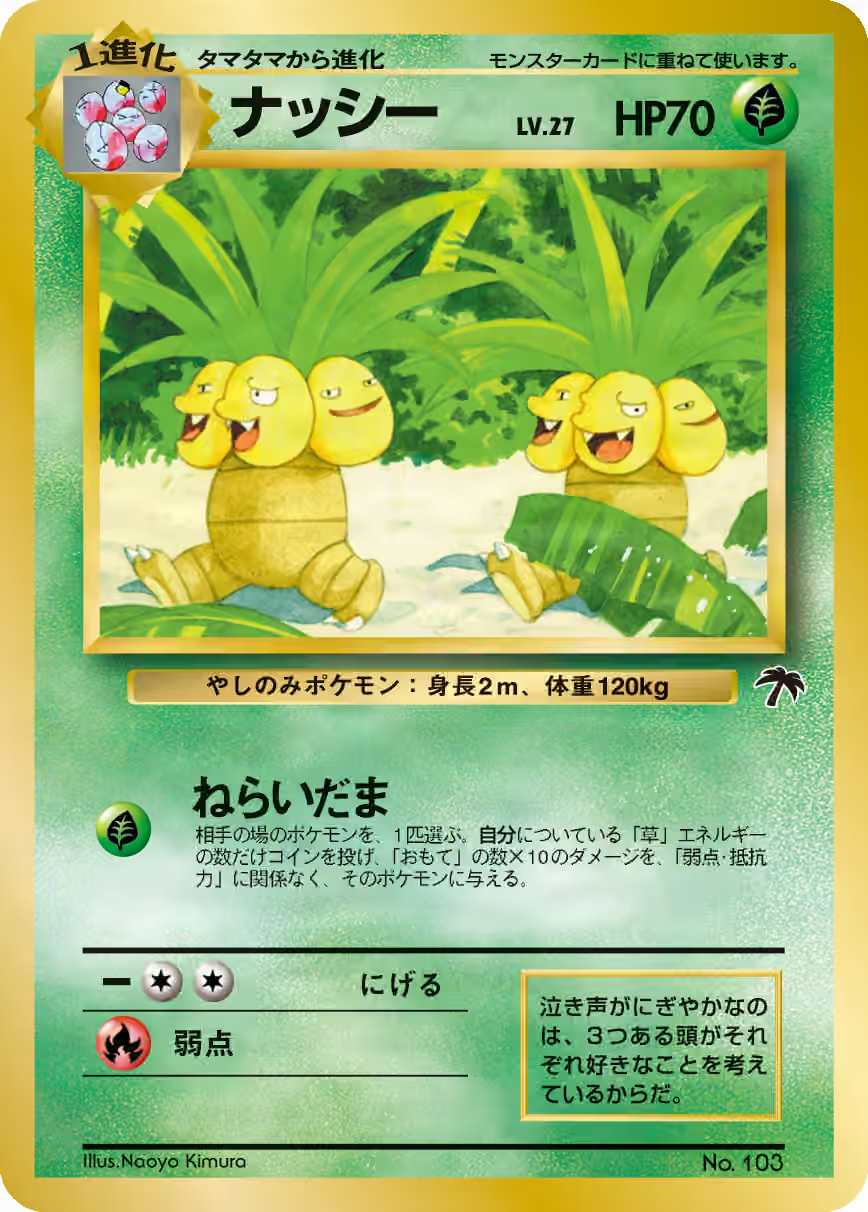
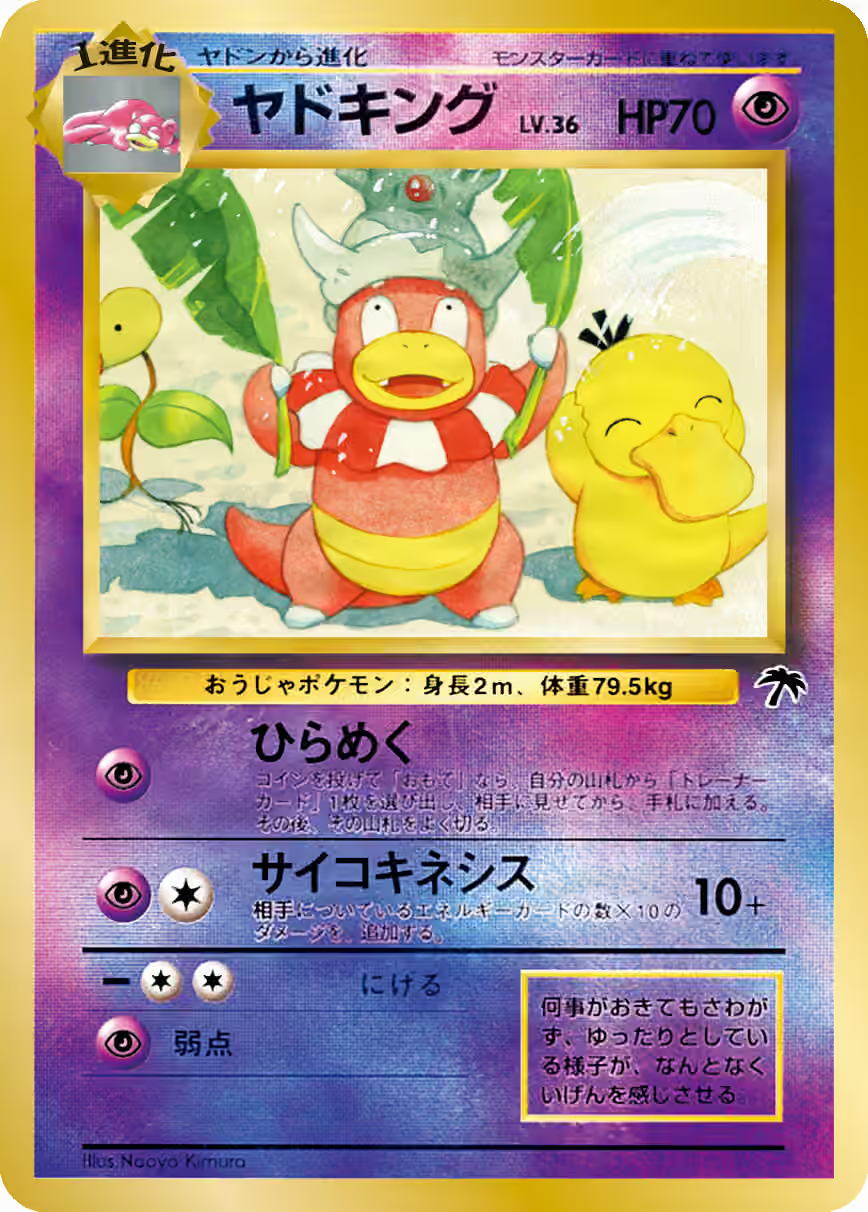
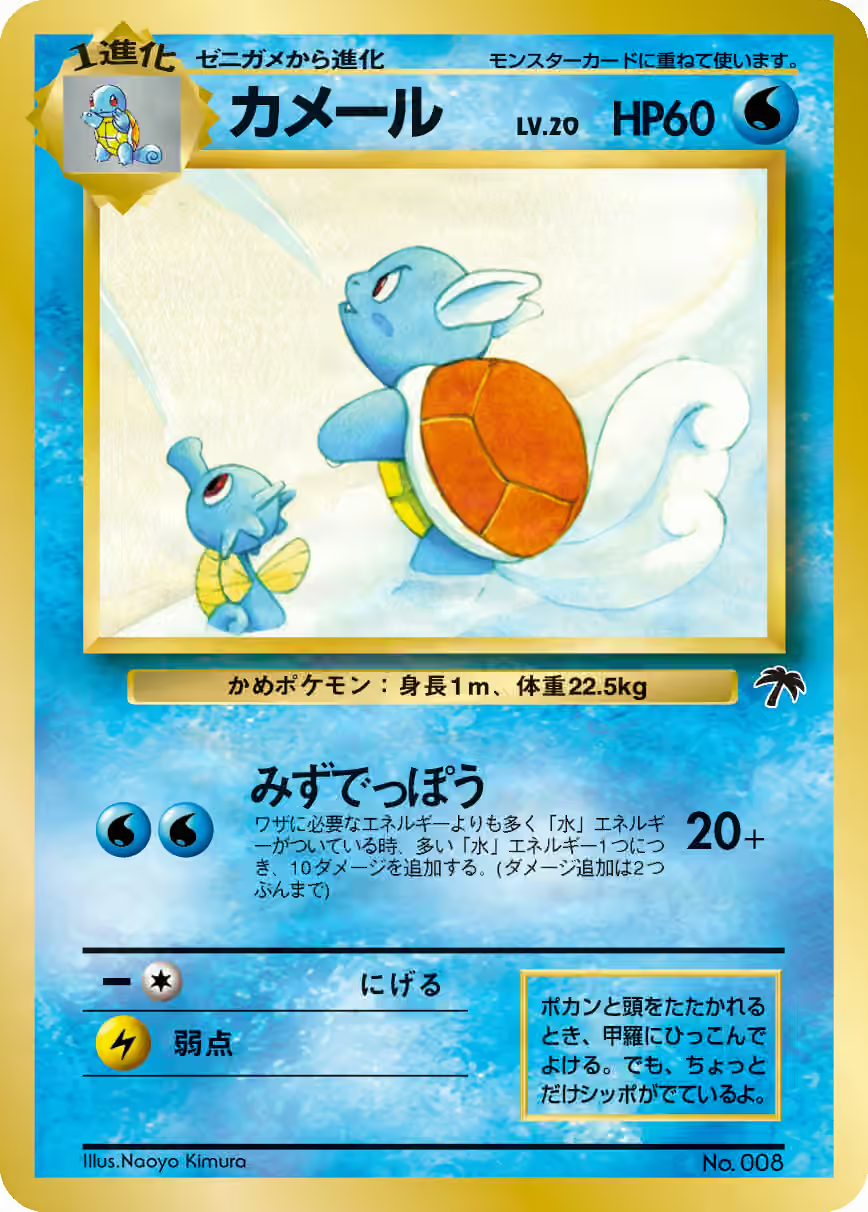
28% of the painting made it onto the cards
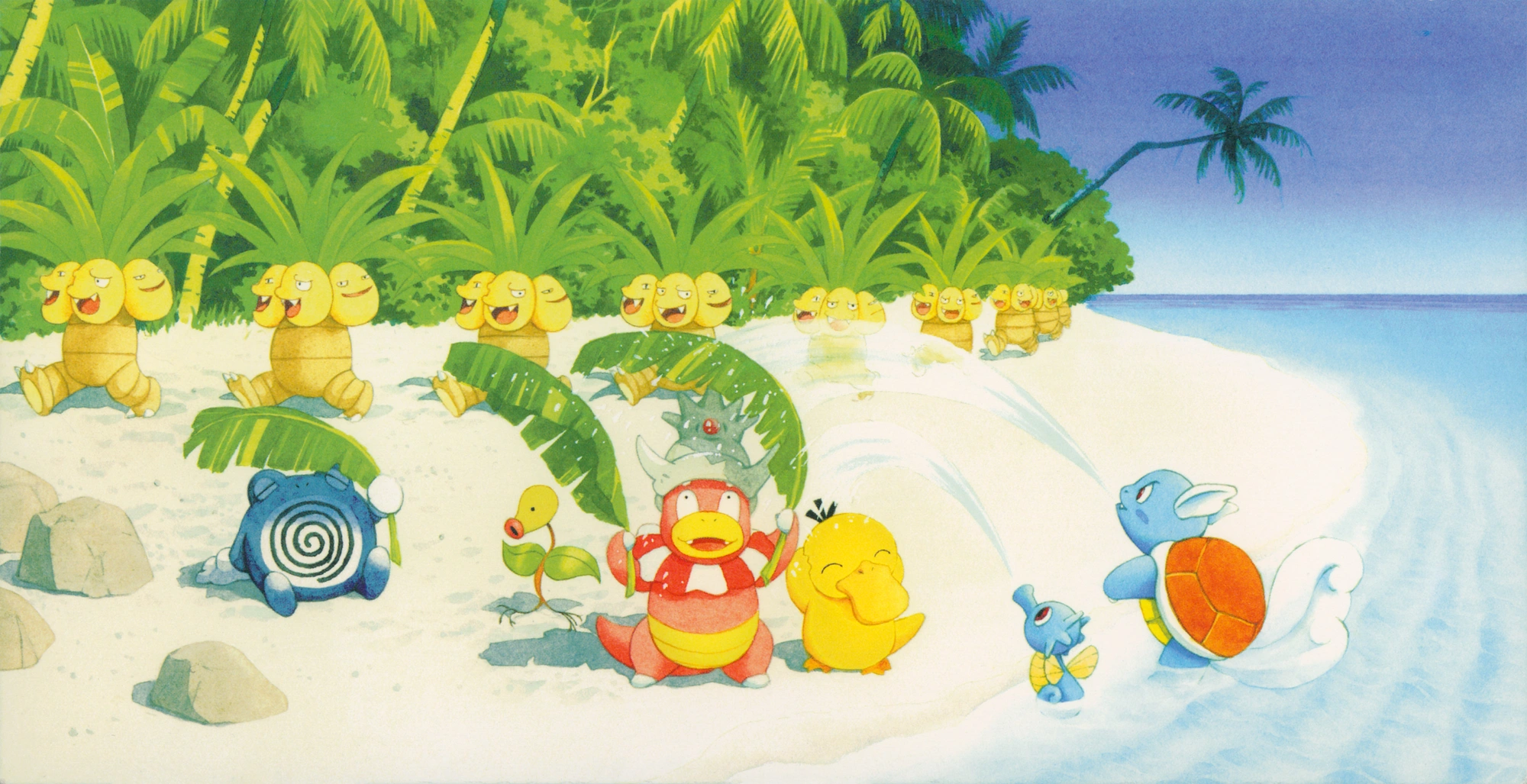
A line of Exeggutor dances along the edge of the trees. Slowking keeps the sun off under a leaf, Psyduck holds its head, and Wartortle sprays water up the sand.
Also here, without a card: Poliwhirl, Bellsprout, Psyduck, Horsea.
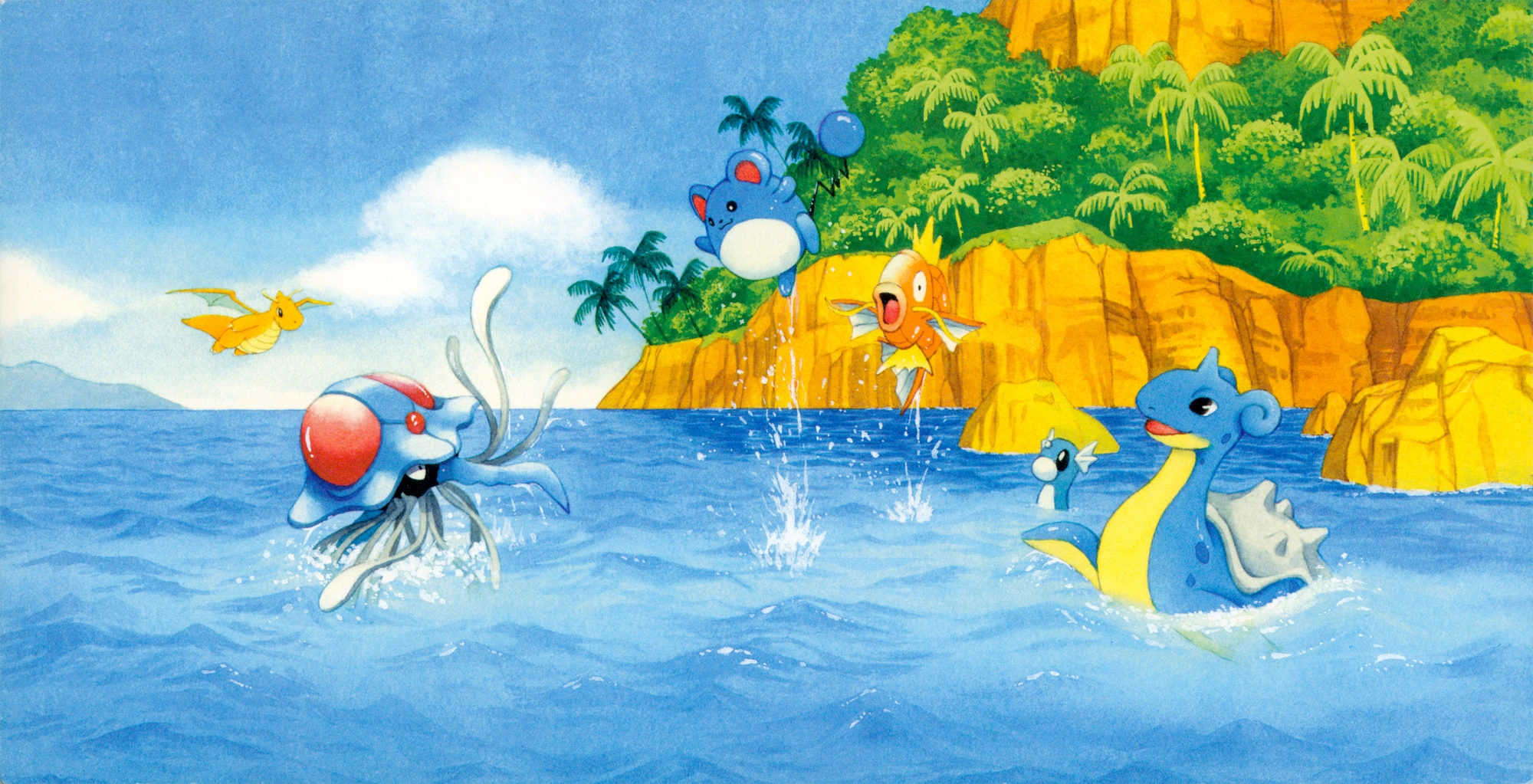
- Dragonite
- Magikarp
- Dratini
Sea
Naoyo Kimura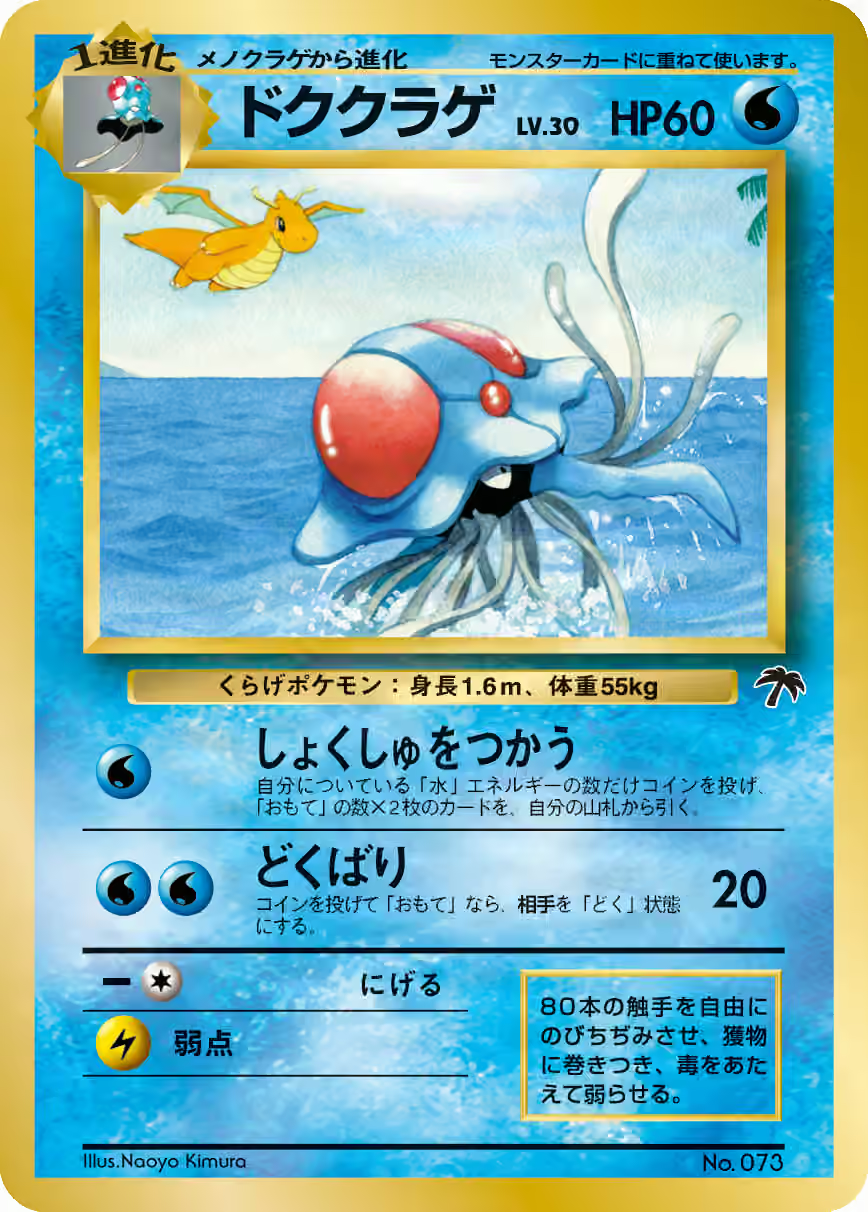
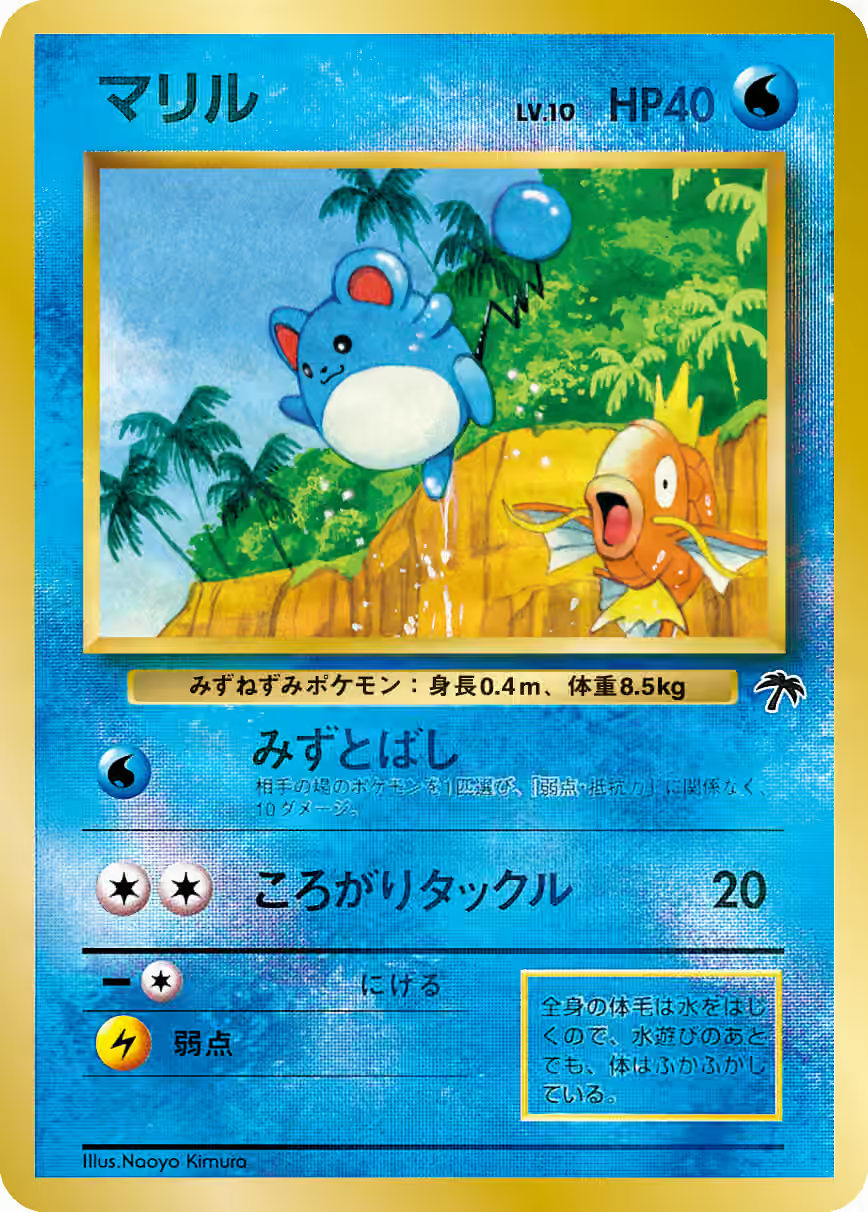
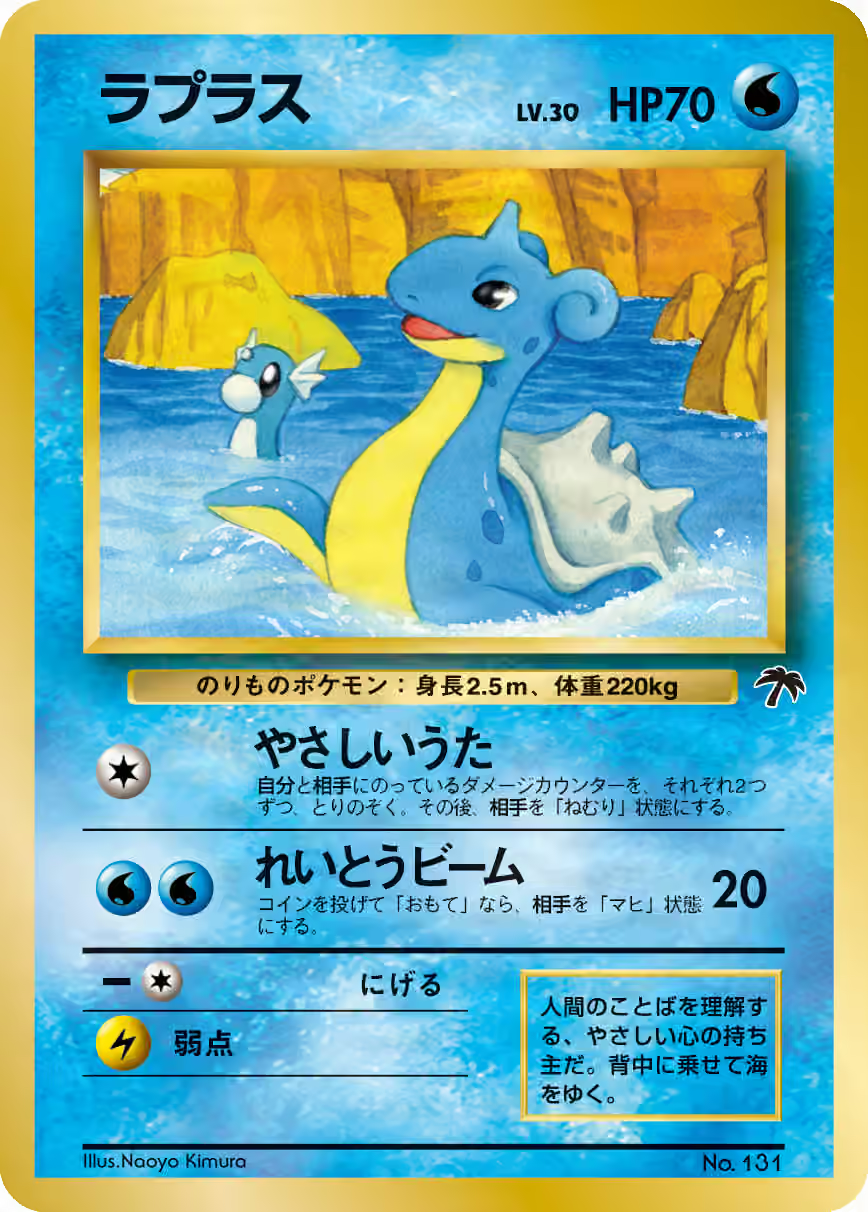
30% of the painting made it onto the cards
Tentacruel bursts out of the waves, Marill floats over the cliffs hanging from its own tail like a balloon, and Lapras swims for the shore with a Dratini beside it.
Also here, without a card: Dragonite, Magikarp, Dratini.
2001 · In English
Two summers later
Southern Islands reached English on 31 July 2001, as a single collection: a binder holding all eighteen cards, with the six scenes as postcards. By then the surprise had gone. Neo Genesis had brought Togepi, Marill, Ledyba and Slowking to English seven months earlier, and Wizards of the Coast’s FAQ said the cards featured Pokémon “from the first 150 cards and the recently released Neo expansions”.
The holos changed too. Each of the six is a reverse holo in English, the shine taken off the painting and put on the frame around it, and that is the only way the English six were ever printed.
A wider window
The paintings came over whole, but the new frames don’t crop them the way the old ones did. Matched against their Japanese cards, the English Rainbow Island cards show much the same picture, from 5% less to 14% more. Kimura’s show more: the three Beach cards about 28% more of their painting, and Lickitung and Primeape nearly half as much again.
Together the English Jungle cards show 36% of the painting, where the Japanese cards show 27%. In English, Lickitung gets the rest of its body and a Venonat peeking in at the edge, and Primeape gets its feet.
Pokémon and Pokémon character names are trademarks of Nintendo, Creatures and GAME FREAK. Card pictures and text © The Pokémon Company, Nintendo, Creatures, GAME FREAK and, for older cards, Wizards of the Coast. PennySleeve is not produced, endorsed, sponsored or supported by, or affiliated with, any of them.